Ch 1: Real Numbers Class 10 Maths NCERT Solutions

Chapter 1: Real Numbers — Exercise 1.1
Mastering the “Fundamental Theorem of Arithmetic” is like finding the DNA of numbers—once you break them down into their prime building blocks, you can solve almost any problem involving HCF and LCM with ease!
Q1. Express each number as a product of its prime factors:
i) 140
The Logic: We keep dividing the number by the smallest prime numbers (2, 3, 5, 7…) until we are left with 1. Think of it as a “Factor Tree.”
The Steps:
140 / 2 = 70
70 / 2 = 35
35 / 5 = 7
7 / 7 = 1
The Result: 140 = 2 x 2 x 5 x 7 = 2^2 x 5 x 7
ii) 156
The Logic: Even numbers are always divisible by 2. Let’s keep shrinking it down.
The Steps:
156 / 2 = 78
78 / 2 = 39
39 / 3 = 13
13 / 13 = 1
The Result: 156 = 2^2 x 3 x 13
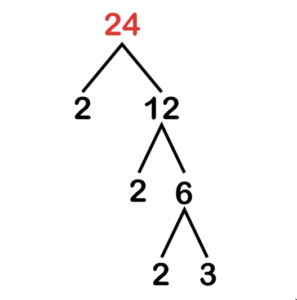
iii) 3825
Human Tip: If the last digit is 5, it’s definitely divisible by 5. But check for 3 first by adding the digits (3+8+2+5 = 18, which is divisible by 3!).
The Steps: 3825 = 3 x 3 x 5 x 5 x 17
The Result: 3^2 x 5^2 x 17
Q2. Find the LCM and HCF and verify that LCM x HCF = Product of the two numbers.
i) 26 and 91
The Logic: HCF is the “Common DNA” (lowest powers), while LCM is the “Total DNA” (highest powers of all factors).
The Steps:
Factors: 26 = 2 x 13 and 91 = 7 x 13
HCF = 13
LCM = 2 x 7 x 13 = 182
Verification: 13 x 182 = 2366 and 26 x 91 = 2366.
The Result: HCF = 13, LCM = 182. (Verified)
Q3. Find the LCM and HCF of the following integers by applying prime factorisation:
i) 12, 15 and 21
The Logic: Same as Q2, but now we compare three numbers at once.
The Steps:
12 = 2^2 x 3
15 = 3 x 5
21 = 3 x 7
HCF (Common to all): 3
LCM (All factors with highest power): 2^2 x 3 x 5 x 7 = 420
The Result: HCF = 3, LCM = 420
Q4. Given that HCF(306, 657) = 9, find LCM(306, 657).
The Logic: Use the Pro-Tip Formula that connects HCF and LCM. It saves you from doing long prime factorization!
The Steps:
Formula: HCF x LCM = Product of Numbers
9 x LCM = 306 x 657
LCM = (306 x 657) / 9
LCM = 34 x 657 = 22338
The Result: LCM = 22338
Q5. Check whether 6^n can end with the digit 0 for any natural number n.
The Logic: For a number to end in 0, it must have factors 2 and 5 (2 x 5 = 10).
The Steps:
Prime factors of 6 = 2 x 3.
So, 6^n = (2 x 3)^n.
There is no 5 in the prime factorization of 6.
The Result: No, 6^n cannot end with 0 because it lacks the prime factor 5.
Q6. Explain why (7 x 11 x 13 + 13) and (7 x 6 x 5 x 4 x 3 x 2 x 1 + 5) are composite numbers.
The Logic: A composite number is any number that has more factors than just 1 and itself. If we can “take out” a common factor, it’s composite!
The Steps:
Expression 1: 13(7 x 11 + 1) = 13(78). Since it has factors other than 1, it is composite.
Expression 2: 5(7 x 6 x 4 x 3 x 2 x 1 + 1) = 5(1009). Since it has 5 as a factor, it is composite.
The Result: Both are composite because they can be expressed as a product of prime factors.
Q7. Sonia takes 18 min, Ravi takes 12 min. When will they meet again at the starting point?
The Logic: They will meet at a time that is a common multiple of both. Since we want the first time they meet, we find the Least Common Multiple (LCM).
The Steps:
18 = 2 x 3^2
12 = 2^2 x 3
LCM = 2^2 x 3^2 = 4 x 9 = 36.
The Result: They will meet again after 36 minutes.
Summary Table
| Concept | Key Secret | Formula / Rule |
| Prime Factor | The “DNA” of a number | Only use 2, 3, 5, 7, 11, 13… |
| HCF | The “Common Ground” | Product of Smallest powers of common factors |
| LCM | The “Full House” | Product of Greatest powers of all factors |
| The Gold Rule | Only for 2 numbers! | HCF x LCM = a x b |
Chapter 1: Real Numbers — Exercise 1.2
Welcome to the world of “Irrationality”! This exercise is a favorite for board exams because it teaches you how to prove that some numbers simply cannot be tamed into regular fractions.
Q1. Prove that root 5 is irrational.
-
The Logic: We use a “Secret Weapon” called Proof by Contradiction. We start by pretending that root 5 is rational (a simple fraction). Then, we do some math to show that this leads to a ridiculous result. If our result is wrong, our starting assumption must be wrong too!
-
The Steps:
-
Let us assume, to the contrary, that root 5 is rational.
-
So, we can write root 5 = a/b, where ‘a’ and ‘b’ are co-prime (they have no common factors other than 1) and b is not 0.
-
Squaring both sides: 5 = a^2 / b^2.
-
Rearranging: a^2 = 5b^2.
-
This means a^2 is divisible by 5, and therefore ‘a’ is also divisible by 5.
-
Now, let a = 5c for some integer ‘c’.
-
Substitute this into our equation: (5c)^2 = 5b^2 => 25c^2 = 5b^2 => 5c^2 = b^2.
-
This means b^2 is divisible by 5, so ‘b’ is also divisible by 5.
-
Wait! We found that both ‘a’ and ‘b’ have 5 as a common factor. But we said they were co-prime!
-
-
The Result: Our assumption was wrong. Therefore, root 5 is irrational.
Q2. Prove that 3 + 2 root 5 is irrational.
-
The Logic: This is much easier! We use the fact that we already know root 5 is irrational. If you mix a rational number with an irrational one, the whole thing becomes irrational.
-
The Steps:
-
Assume 3 + 2 root 5 is rational. So, 3 + 2 root 5 = a/b.
-
Let’s isolate the “irrational part” (root 5).
-
2 root 5 = (a/b) – 3
-
2 root 5 = (a – 3b) / b
-
root 5 = (a – 3b) / 2b
-
Since ‘a’ and ‘b’ are integers, the right side (a – 3b) / 2b is a rational number.
-
But we know root 5 is irrational! A rational cannot equal an irrational.
-
-
The Result: Since this is a contradiction, 3 + 2 root 5 is irrational.
Q3. Prove that the following are irrationals:
i) 1 / root 2
-
The Logic: Just like Q1, we flip it and check.
-
The Steps:
-
Assume 1 / root 2 = a/b (rational).
-
So, root 2 = b/a.
-
Since ‘b’ and ‘a’ are integers, b/a is rational.
-
But this contradicts the fact that root 2 is irrational.
-
-
The Result: 1 / root 2 is irrational.
ii) 7 root 5
-
The Logic: If you multiply a non-zero rational (7) by an irrational (root 5), you get an irrational.
-
The Steps:
-
Assume 7 root 5 = a/b.
-
root 5 = a / 7b
-
The right side is rational, but the left side is irrational. Contradiction!
-
-
The Result: 7 root 5 is irrational.
iii) 6 + root 2
-
The Logic: Similar to Q2—adding a rational and an irrational.
-
The Steps:
-
Assume 6 + root 2 = a/b.
-
root 2 = (a/b) – 6 = (a – 6b) / b
-
An irrational cannot equal a rational.
-
-
The Result: 6 + root 2 is irrational.
Summary Table
| Property | Rule to Remember | Example |
| Sum/Difference | Rational +/- Irrational = Irrational | 3 + root 5 |
| Product/Quotient | Rational x Irrational = Irrational | 7 root 5 |
| The “Why” | Proof by Contradiction | Assume rational -> Prove wrong |
| Co-prime | Numbers with HCF = 1 | 2 and 3 are co-prime |
Practice like a Topper with our A+ Practice System!
Join the 1M+ Community at padhayi.com to access 1k+ resources, chapter-wise PYQs, and instant updates. Keep learning, keep growing!
Rate this Resource
Community Rating
Tap to rate
Comments (0)
No comments yet. Be the first to comment!
Please log in to comment
Log In