General Instructions : Read the following instructions very carefully and strictly follow them :
(i) This question paper comprises 39 questions. All questions are compulsory.
(ii) This question paper is divided into five sections – A, B, C, D and E.
(iii) Section A – Questions No. 1 to 20 are Multiple Choice Questions. Each question carries 1 mark.
(iv) Section B – Questions No. 21 to 26 are Very Short Answer type questions. Each question carries 2 marks. Answer to these questions should be in the range of 30 to 50 words.
(v) Section C – Questions No. 27 to 33 are Short Answer type questions. Each question carries 3 marks. Answer to these questions should in the range of 50 to 80 words.
(vi) Section D – Questions No. 34 to 36 are Long Answer type questions. Each question carries 5 marks. Answer to these questions should be in the range of 80 to 120 words.
(vii) Section E – Questions No. 37 to 39 are of 3 source-based/case-based units of assessment carrying 4 marks each with sub-parts.
(viii) There is no overall choice. However, an internal choice has been provided in some sections. Only one of the alternatives has to be attempted in such questions.
SECTION A
Select and write the most appropriate option out of the four options given for each of the questions no. 1 to 20. There is no negative marking for incorrect response.
Electrolysis of water is a decomposition reaction. The mass ratio $(M_{H}:M_{O})$ of hydrogen and oxygen gases liberated at the electrodes during electrolysis of water is :
[1 marks]
The products formed when Aluminium and Magnesium are burnt in the presence of air respectively are:
[1 marks]
The following table shows the pH values of four solutions A, B, C and D on a pH scale :
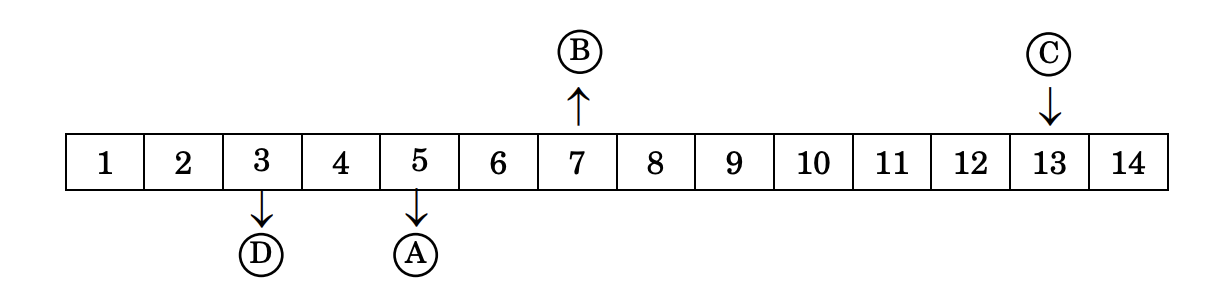
The solutions A, B, C and D respectively are of a
[1 marks]
Consider the following reactions:
(i) Dilute hydrochloric acid reacts with sodium hydroxide.
(ii) Magnesium oxide reacts with dilute hydrochloric acid.
(iii) Carbon dioxide reacts with sodium hydroxide.
It is found that in each case:
[1 marks]
Reaction between two elements A and B, forms a compound C. A loses electrons and B gains electrons. Which one of the following properties will not be shown by compound C?
[1 marks]
The metals obtained from their molten chlorides by the process of electrolytic reduction are:
[1 marks]
The formation of magnesium oxide is correctly shown in option :
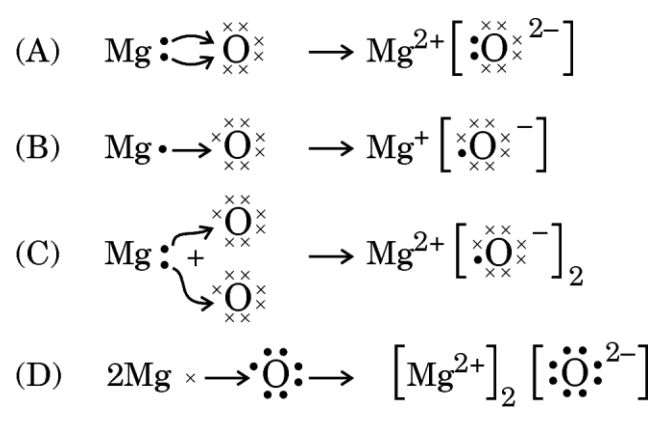
[1 marks]
Secretion of less saliva in mouth will effect the conversion of:
[1 marks]
The plant hormone whose concentration stimulates the cells to grow longer on the side of the shoot which is away from light is:
[1 marks]
The correct/true statement(s) for a bisexual flower is/are:
(i) They possess both stamen and pistil.
(ii) They possess either stamen or pistil.
(iii) They exhibit either self-pollination or cross-pollination.
(iv) They cannot produce fruits on their own.
[1 marks]
If pea plants with round and green seeds (RRyy) are crossed with pea plants having wrinkled and yellow seeds (rrYY), the seeds developed by the plants of $F_{1}$ generation will be :
[1 marks]
The breakdown of glucose has taken the following pathway:
Glucose $\xrightarrow{(a)}$ Pyruvate + Energy $\xrightarrow{(b)}$ Lactic acid + Energy
The sites 'a' and 'b' respectively are :
[1 marks]
Mirror 'X' is used to concentrate sunlight in solar furnace and Mirror 'Y' is fitted on the side of the vehicle to see the traffic behind the driver. Which of the following statements are true for the two mirrors?
(i) The image formed by mirror 'X' is real, diminished and at its focus.
(ii) The image formed by mirror 'Y' is virtual, diminished and erect.
(iii) The image formed by mirror 'X' is virtual, diminished and erect.
(iv) The image formed by mirror 'Y' is real, diminished and at its focus.
[1 marks]
An old person is suffering from an eye defect caused by weakening of ciliary muscles and diminishing flexibility of the eye lens. If the defect of vision is 'a' which can be corrected by lens 'b', then 'a' and 'b' respectively are:
[1 marks]
Which of the following groups do not constitute a food chain?
(i) Wolf, rabbit, grass, lion
(ii) Plankton, man, grasshopper, fish
(iii) Hawk, grass, snake, grasshopper, frog
(iv) Grass, snake, wolf, tiger
[1 marks]
The percentage of solar energy which is not converted into food energy by the leaves of green plants in a terrestrial ecosystem is about:
[1 marks]
Assertion (A): Decomposition reactions are generally endothermic reactions.
Reason (R): Decomposition of organic matter into compost is an exothermic process.
[1 marks]
Assertion (A): A human child bears all the basic features of human beings.
Reason (R): It looks exactly like its parents, showing very little variations.
[1 marks]
Assertion (A): No two magnetic field lines are found to cross each other.
Reason (R): The compass needle cannot point towards two directions at the point of intersection of two magnetic field lines.
[1 marks]
Assertion (A): The amount of ozone in the atmosphere began to drop sharply in the 1980s.
Reason (R): The oxygen atoms combine with molecular oxygen to form ozone.
[1 marks]
SECTION B
Questions no. 21 to 26 are Very Short Answer Type questions.
A student performs the following experiment in his school laboratory.
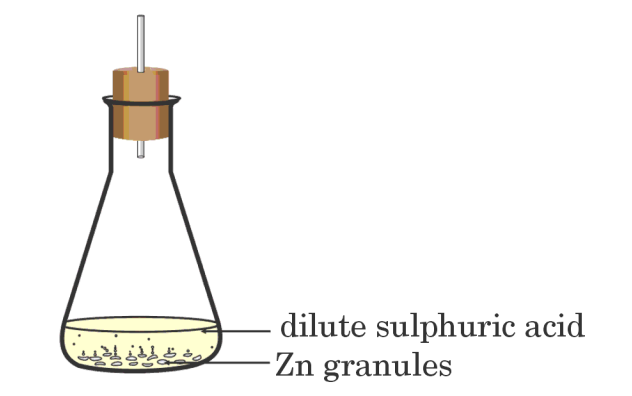
List two observations to justify that in this experiment a chemical change has taken place.
[2 marks]
Draw labelled diagrams to show different stages of budding in Hydra.
[2 marks]
| (a) | Besides minimising the loss of blood, why is it essential to plug any leak in a blood vessel ? Name the component of blood which helps in this process and state how this component perform this function. | ||||
| OR | |||||
| (b) |
|
[2 marks]
An object is placed at a distance of 60 cm from a concave lens of focal length 30 cm. Use lens formula to find the position of the image formed in this case.
[2 marks]
| (a) | A wire of resistance R is cut into three equal parts. If these three parts are then joined in parallel, calculate the total resistance of the combination so formed. |
| OR | |
| (b) | Define electric power. When do we say that the power consumed in an electric circuit is 1 watt? |
[2 marks]
"Excessive use of chemicals and pesticides in agriculture adversely effect the environment." Justify this statement.
[2 marks]
SECTION C
Questions no. 27 to 33 are Short Answer Type questions.
| (a) | "Displacement reactions also play a key role in extracting metals in the middle of the reactivity series." Justify this statement with two examples. |
| (b) | Why can metals high up in the reactivity series not be obtained by reduction of their oxides by carbon ? |
[3 marks]
| (a) | With the help of an activity, explain the conditions under which iron articles get rusted. | ||||
| OR | |||||
| (b) |
|
[3 marks]
Plants have neither a nervous system nor muscles, even then they respond to stimuli. For example, the leaves of chhui-mui (touch-me-not) plant when touched begin to fold up and droop.
(a) How is the information communicated in "touch-me-not" plants?
(b) What enables the plant cells to bring out the observable response ?
(c) Differentiate the movement mentioned above from the movement of tendrils in a pea plant.
[3 marks]
| (a) | What are chromosomes? |
| (b) | Explain in brief how stability of DNA content of a species is ensured in sexually reproducing organisms? |
[3 marks]
Draw ray diagrams to show the nature, position and relative size of the image formed by a convex mirror when the object is placed (i) at infinity and (ii) between infinity and pole P of the mirror.
[3 marks]
Consider the following electric circuit :
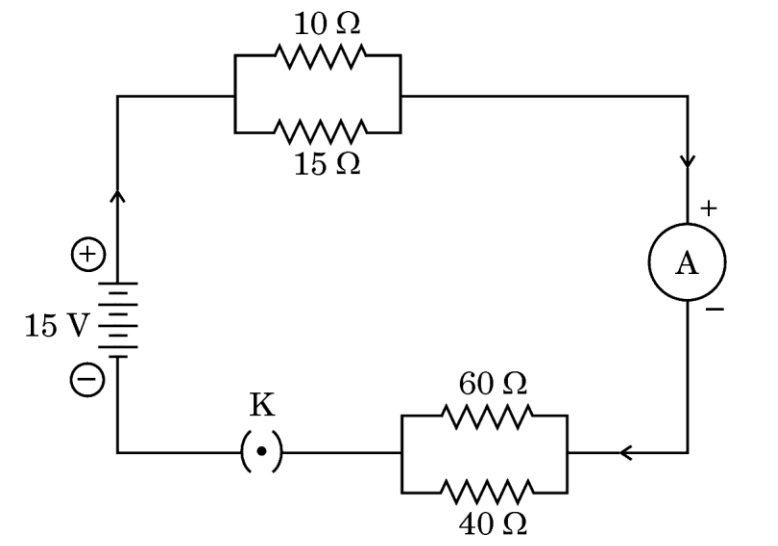
Calculate the values of the following:
(a) The total resistance of the circuit
(b) The total current drawn from the source
(c) Potential difference across the parallel combination of 10 $\Omega$ and 15 $\Omega$ resistors
[3 marks]
|
(a) |
Write the relationship between resistivity and resistance of a cylindrical conductor of length $l$ and area of cross-section $A$. Hence derive the SI unit of resistivity. |
| (b) | Why are alloys used in electrical heating devices? |
[3 marks]
SECTION D
Questions no. 34 to 36 are Long Answer Type questions.
| (a) |
|
||||||
|
OR |
|||||||
| (b) |
|
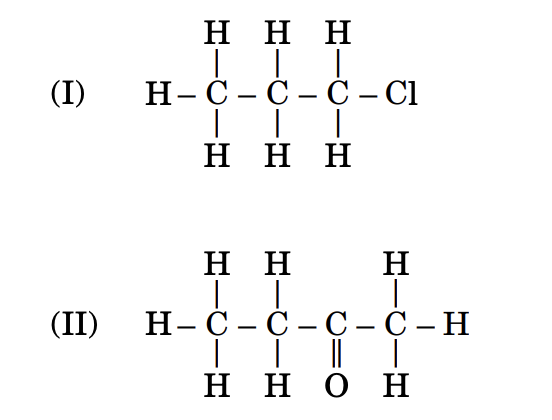
[5 marks]
| (a) |
|
||||
| OR | |||||
| (b) |
|
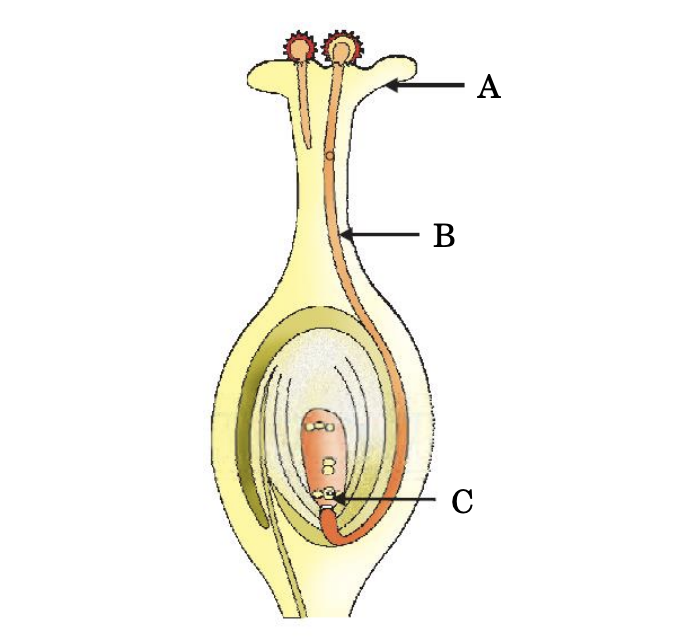
[5 marks]
| (a) |
|
||||||||||||||
| OR | |||||||||||||||
| (b) |
|
[5 marks]
SECTION E
The following questions are Source-based/Case-based questions. Read the case carefully and answer the questions that follow.
Seawater contains many salts dissolved in it. Common salt is separated from these salts. Deposits of solid salt are also found in several parts of the world. These large crystals are often brown due to impurities. This is called rock salt and is mined like coal. The common salt is an important raw material for chemicals of daily use.
| (a) | Write balanced chemical equations to show the products formed during electrolysis of brine. |
| (b) | List two uses of any one product obtained during electrolysis of brine. |
| (c) | (i) A mild non-corrosive basic salt ‘A’, used for faster cooking, is strongly heated to produce a compound ‘B’, that is used for removing permanent hardness of water. Identify A and B and also write the equation for the reaction that occurs when A is heated. |
| OR | |
| (c) | (ii) Define water of crystallisation. Give two examples of salts that have water of crystallisation. |
[4 marks]
The maintenance functions of all living organisms must go on even when they are not doing anything particular. Even when we are just sitting in a class or even asleep, this maintenance job has to go on. These maintenance processes require energy to prevent damage and break-down of cells and tissues, which is obtained by the individual organism from the food prepared by the autotrophs, called producers
| (a) | Name and define the process by which green plants prepare food. |
| (b) | Write chemical equation involved in the above process. |
| (c) | (i) A mild non-corrosive basic salt ‘A’, used for faster cooking, is strongly heated to produce a compound ‘B’, that is used for removing permanent hardness of water. Identify A and B and also write the equation for the reaction that occurs when A is heated. |
| OR | |
| (c) | (ii) Define water of crystallisation. Give two examples of salts that have water of crystallisation. |
[4 marks]
In our homes, we receive the supply of electric power through a main supply also called mains, either supported through overhead electric poles or by underground cables. In our country the potential difference between the two wires (live wire and neutral wire) of this supply is 220 V.
| (a) | Write the colours of the insulation covers of the line wires through which supply comes to our homes. |
| (b) | What should be the current rating of the electric circuit (220 V) so that an electric iron of 1 kW power rating can be operated? |
| (c) | (i) What is the function of the earth wire? State the advantage of the earth wire in domestic electric appliances such as electric iron. |
| OR | |
| (c) | (ii) List two precautions to be taken to avoid electrical accidents. State how these precautions prevent possible damage to the circuit/appliance. |
[4 marks]