General Instructions : Read the following instructions very carefully and strictly follow them :
(i) This question paper comprises 39 questions. All questions are compulsory.
(ii) This question paper is divided into five sections – A, B, C, D and E.
(iii) Section A – Questions No. 1 to 20 are Multiple Choice Questions. Each question carries 1 mark.
(iv) Section B – Questions No. 21 to 26 are Very Short Answer type questions. Each question carries 2 marks. Answer to these questions should be in the range of 30 to 50 words.
(v) Section C – Questions No. 27 to 33 are Short Answer type questions. Each question carries 3 marks. Answer to these questions should in the range of 50 to 80 words.
(vi) Section D – Questions No. 34 to 36 are Long Answer type questions. Each question carries 5 marks. Answer to these questions should be in the range of 80 to 120 words.
(vii) Section E – Questions No. 37 to 39 are of 3 source-based/case-based units of assessment carrying 4 marks each with sub-parts.
(viii) There is no overall choice. However, an internal choice has been provided in some sections. Only one of the alternatives has to be attempted in such questions.
SECTION A
Select and write the most appropriate option out of the four options given for each of the questions no. 1 to 20. There is no negative marking for incorrect response.
When 2 mL of sodium hydroxide solution is added to few pieces of granulated zinc in a test tube and then warmed, the reaction that occurs can be written in the form of a balanced chemical equation as :
[1 marks]
$\ce{NaOH + Zn \rightarrow NaZnO2 + H2O}$
Select from the following a decomposition reaction in which source of energy for decomposition is light :
[1 marks]
A metal and a non-metal that exists in liquid state at the room temperature are respectively:
[1 marks]
Carbon compounds:
(i) are good conductors of electricity.
(ii) are bad conductors of electricity.
(iii) have strong forces of attraction between their molecules.
(iv) have weak forces of attraction between their molecules.
The correct statements are:
[1 marks]
Consider the following compounds :
$\ce{FeSO4}$; $\ce{CuSO4}$; $\ce{CaSO4}$; $\ce{Na2CO3}$
The compound having maximum number of water of crystallisation in its crystalline form in one molecule is:
[1 marks]
Oxides of aluminium and zinc are:
$\ce{MnO2 + 4HCl \rightarrow MnCl2 + 2H2O + Cl2}$
The reaction given above is a redox reaction because in this case :
[1 marks]
Consider the following statements:
(i) The sex of a child is determined by what it inherits from the mother.
(ii) The sex of a child is determined by what it inherits from the father.
(iii) The probability of having a male child is more than that of a female child.
(iv) The sex of a child is determined at the time of fertilisation when male and female gametes fuse to form a zygote.
The correct statements are:
[1 marks]
Chromosomes:
(i) carry hereditary information from parents to the next generation.
(ii) are thread like structures located inside the nucleus of an animal cell.
(iii) always exist in pairs in human reproductive cells.
(iv) are involved in the process of cell division.
The correct statements are:
[1 marks]
In a nerve cell, the site where the electrical impulse is converted into a chemical signal is known as:
[1 marks]
A stomata closes when :
(i) it needs carbon dioxide for photosynthesis.
(ii) it does not need carbon dioxide for photosynthesis.
(iii) water flows out of the guard cells.
(iv) water flows into the guard cells.
The correct reason(s) in this process is/are :
[1 marks]
At what distance from a convex lens should an object be placed to get an image of the same size as that of the object on a screen ?
[1 marks]
The lens system of human eye forms an image on a light sensitive screen, which is called as:
[1 marks]
The pattern of the magnetic field produced inside a current carrying solenoid is:
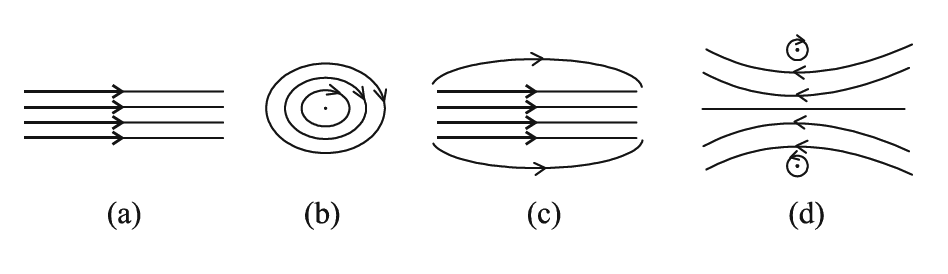
[1 marks]
Identify the food chain in which the organisms of the second trophic level are missing:
[1 marks]
In which of the following organisms, multiple fission is a means of asexual reproduction?
[1 marks]
For Questions number 17 to 20, two statements are given — one labelled as Assertion (A) and the other labelled as Reason (R). Select the correct answer to these questions from the codes (A), (B), (C) and (D) as given below.
Two statements are given - One labelled as Assertion (A) and the other labelled as Reason (R). Select the correct answer to these questions from the codes (a), (b), (c) and (d) as given below :
- Assertion (A): Hydrogen gas is not evolved when zinc reacts with nitric acid.
- Reason (R): Nitric acid oxidises the hydrogen gas produced to water and itself gets reduced.
[1 marks]
Assertion (A): Accumulation of harmful chemicals is maximum in the organisms at the highest trophic level of a food chain.
Reason (R): Harmful chemicals are sprayed on the crops to protect them from diseases and pests.
[1 marks]
Assertion (A): The rate of breathing in aquatic organisms is much faster than in terrestrial organisms.
Reason (R): The amount of oxygen dissolved in water is very high as compared to the amount of oxygen in air.
[1 marks]
Assertion (A): The rainbow is a natural spectrum of sunlight in the sky.
Reason (R): Rainbow is formed in the sky when the sun is overhead and water droplets are also present in air.
[1 marks]
SECTION B
Questions no. 21 to 26 are Very Short Answer Type questions.
Name the type of chemical reaction in which calcium oxide reacts with water. Justify your answer by giving balanced chemical equation for the chemical reaction.
[2 marks]
State one role of each of the following in human digestive system :
(i) Hydrochloric acid
(ii) Villi
(iii) Anal Sphincter
(iv) Lipase
[2 marks]
| (A) |
How is the movement of leaves of a sensitive plant different from the downward movement of the roots? |
| OR | |
| (B) | There is a hormone which regulates carbohydrate, protein and fat metabolism in our body. Name the hormone and the gland which secretes it. Why is it important for us to have iodised salt in our diet? |
[2 marks]
An object is placed at a distance of 10 cm from a convex mirror of focal length 15 cm. Find the position of the image formed by the mirror.
[2 marks]
(A) Show how you would connect three resistors each of resistance 6 $\Omega$, so that the combination has a resistance of 9 $\Omega$. Also justify your answer.
OR
(B) In the given circuit calculate the power consumed in watts in the resistor of 2 $\Omega$:
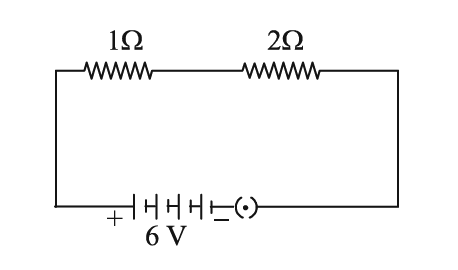
[2 marks]
- Two magnetic field lines do not intersect each other. Why?
- How is a uniform magnetic field in a given region represented ? Draw a diagram in support of your answer.
[2 marks]
SECTION C
Questions no. 27 to 33 are Short Answer Type questions.
Write one chemical equation each for the chemical reaction in which the following have taken place :
(i) Change in colour
(ii) Change in temperature
(iii) Formation of precipitate
Mention colour change/temperature change (rise/fall)/compound precipitated along with equation.
[3 marks]
(i) The pH of a sample of tomato juice is 4.6. How is this juice likely to be in taste ? Give reason to justify your answer.
(ii) How do we differentiate between a strong acid and a weak base in terms of ion-formation in aqueous solutions ?
(iii) The acid rain can make the survival of aquatic animals difficult. How?
[3 marks]
(i) Why is respiratory pigment needed in multicellular organisms with large body size ?
(ii) Give reasons for the following:
-
- Rings of cartilage are present in the throat.
- Lungs always contain a residual volume of air.
- The diaphragm flattens and ribs are lifted up when we breathe in.
- Walls of alveoli contain an extensive network of blood vessels.
[3 marks]
Define reflex action. With the help of a flow chart show the path of a reflex action such as sneezing.
[3 marks]
Study the diagram given below and answer the questions that follow :
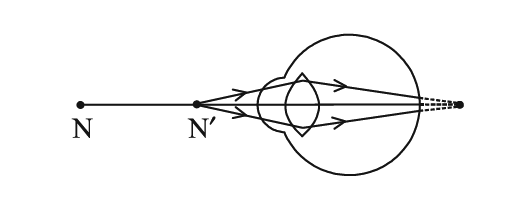
(i) Name the defect of vision represented in the diagram. Give reason for your answer.
(ii) List two causes of this defect.
(iii) With the help of a diagram show how this defect of vision is corrected.
[3 marks]
Name and state the rule to determine the direction of a:
(i) magnetic field produced around a current carrying straight conductor.
(ii) force experienced by a current carrying straight conductor placed in a magnetic field which is perpendicular to it.
[3 marks]
| (A) | Plants $\rightarrow$ Deer $\rightarrow$ Lion In the given food chain, what will be the impact of removing all the organisms of second trophic level on the first and third trophic level? Will the impact be the same for the organisms of the third trophic level in the above food chain if they were present in a food web? Justify. |
| OR | |
| (B) | A gas 'X' which is a deadly poison is found at the higher levels of atmosphere and performs an essential function. Name the gas and write the function performed by this gas in the atmosphere. Which chemical is linked to the decrease in the level of this gas? What measures have been taken by an international organization to check the depletion of the layer containing this gas? |
[3 marks]
SECTION D
Questions no. 34 to 36 are Long Answer Type questions.
| (A) |
|
||||||||
| OR | |||||||||
| (B) |
|
[5 marks]
| (A) |
|
||||
| OR | |||||
| (B) |
|
[5 marks]
| (A) |
|
||||||
| OR | |||||||
| (B) |
|
[5 marks]
SECTION E
The following questions are Source-based/Case-based questions. Read the case carefully and answer the questions that follow.
Q. Nos. are source-based/case-based questions with 2 to 3 short sub-parts. Internal choice is provided in one of these sub-parts :
The metals produced by various reduction processes are not very pure. They contain impurities, which must be removed to obtain pure metals. The most widely used method for refining impure metals is electrolytic refining.
(i) What is the cathode and anode made of in the refining of copper by this process?
(ii) Name the solution used in the above process and write its formula.
(iii) (A) How copper gets refined when electric current is passed in the electrolytic cell?
OR
(iii) (B) You have two beakers 'A' and 'B' containing copper sulphate solution. What would you observe after about 2 hours if you dip a strip of zinc in beaker 'A' and a strip of silver in beaker 'B'? Give reason for your observations in each case.
[4 marks]
Mendel worked out the rules of heredity by working on garden pea using a number of visible contrasting characters. He conducted several experiments by making a cross with one or two pairs of contrasting characters of pea plant. On the basis of his observations he gave some interpretations which helped to study the mechanism of inheritance.
(i) When Mendel crossed pea plants with pure tall and pure short characteristics to produce $F_{1}$ progeny, which two observations were made by him in $F_{1}$ plants?
(ii) Write one difference between dominant and recessive trait.
(iii) (A) In a cross with two pairs of contrasting characters
RRYY X rryy
(Round Yellow) (Wrinkled Green)
Mendel observed 4 types of combinations in $F_{2}$ generation. By which method did he obtain $F_{2}$ generation? Write the ratio of the parental combinations obtained and what conclusions were drawn from this experiment.
OR
(iii) (B) Justify the statement: "It is possible that a trait is inherited but may not be expressed."
[4 marks]
Study the data given below showing the focal length of three concave mirrors A, B and C and the respective distances of objects placed in front of the mirrors:
| Case | Mirror | Focal Length (cm) | Object Distance (cm) |
| 1 | A | 20 | 45 |
| 2 | B | 15 | 30 |
| 3 | C | 30 | 20 |
(i) In which one of the above cases the mirror will form a diminished image of the object? Justify your answer.
(ii) List two properties of the image formed in case 2.
(iii) (A) What is the nature and size of the image formed by mirror C? Draw ray diagram to justify your answer.
OR
(iii) (B) An object is placed at a distance of 18 cm from the pole of a concave mirror of focal length 12 cm. Find the position of the image formed in this case.
[4 marks]