General Instructions : Read the following instructions very carefully and strictly follow them :
(i) This question paper comprises 39 questions. All questions are compulsory.
(ii) This question paper is divided into five sections – A, B, C, D and E.
(iii) Section A – Questions No. 1 to 20 are Multiple Choice Questions. Each question carries 1 mark.
(iv) Section B – Questions No. 21 to 26 are Very Short Answer type questions. Each question carries 2 marks. Answer to these questions should be in the range of 30 to 50 words.
(v) Section C – Questions No. 27 to 33 are Short Answer type questions. Each question carries 3 marks. Answer to these questions should in the range of 50 to 80 words.
(vi) Section D – Questions No. 34 to 36 are Long Answer type questions. Each question carries 5 marks. Answer to these questions should be in the range of 80 to 120 words.
(vii) Section E – Questions No. 37 to 39 are of 3 source-based/case-based units of assessment carrying 4 marks each with sub-parts.
(viii) There is no overall choice. However, an internal choice has been provided in some sections. Only one of the alternatives has to be attempted in such questions.
SECTION A
Select and write the most appropriate option out of the four options given for each of the questions no. 1 to 20. There is no negative marking for incorrect response.
In the experimental setup given below, it is observed that on passing the gas produced in the reaction in the solution 'X' the solution 'X' first turns milky and then colourless.
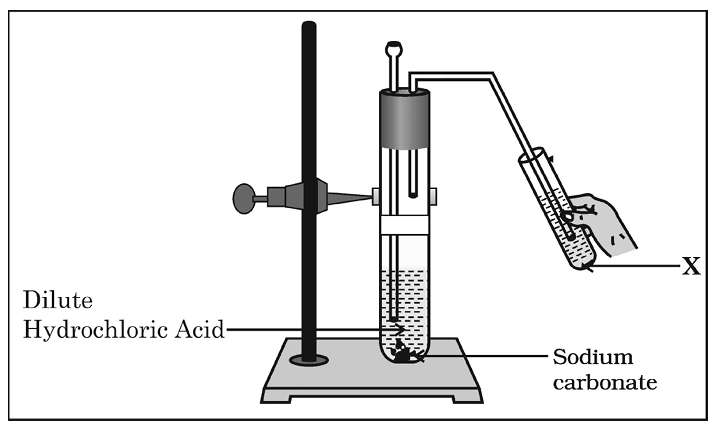
The option that justifies the above stated observation is that 'X' is aqueous calcium hydroxide and
[1 mark]
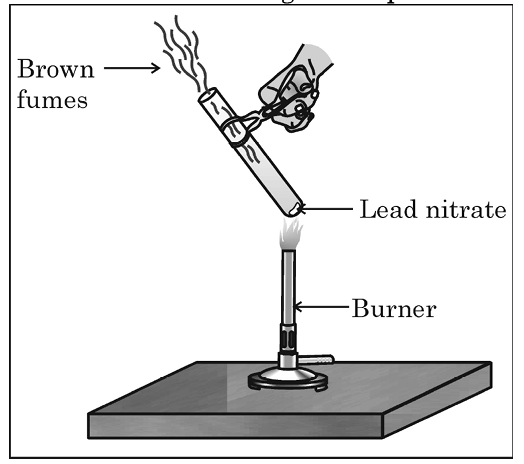
The emission of brown fumes in the given experimental set-up is due to
[1 mark]
\( \ce{MnO2 + x HCl -> MnCl2 + y H2O + z Cl2} \)
In order to balance the above chemical equation, the values of x, y and z respectively are:
[1 mark]
The table below has information regarding pH and the nature (acidic/basic) of four different solutions. Which one of the options in the table is correct?
| Option | Solution | Colour of pH paper | Approximate pH value | Nature of solution |
|---|---|---|---|---|
| (a) | Lemon juice | Orange | 3 | Basic |
| (b) | Milk of magnesia | Blue | 10 | Basic |
| (c) | Gastric juice | Red | 6 | Acidic |
| (d) | Pure water | Yellow | 7 | Neutral |
[1 mark]
A metal 'X' is used in thermite process. When X is burnt in air it gives an amphoteric oxide 'Y'. 'X' and 'Y' are respectively:
[1 mark]
Select washing soda from the following:
[1 mark]
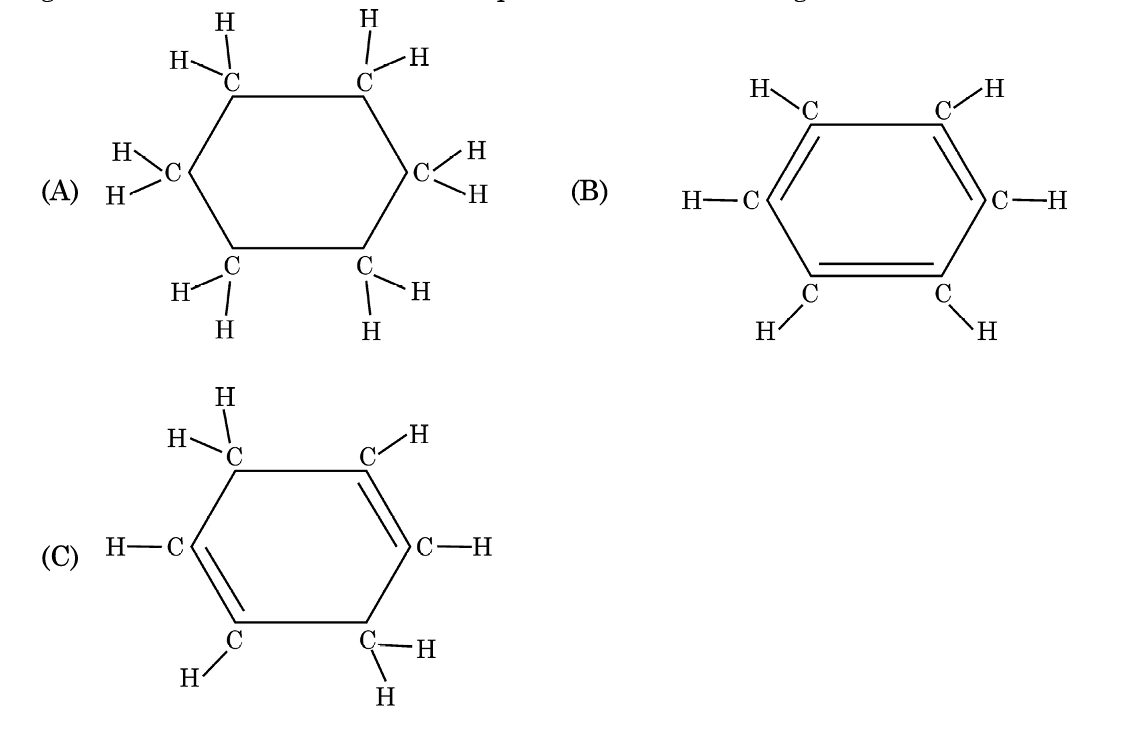
Consider the structures of the three cyclic carbon compounds A, B and C given below and select the correct option from the following:
[1 mark]
An organism which breaks down the food material outside the body and then absorbs it is
[1 mark]
Consider the following statements about small intestine and select the one which is NOT correct:
[1 mark]
The statement that correctly describes the characteristic(s) of a gene is:
[1 mark]
Select from the following the correct statement about tropic movement in plants:
[1 mark]
Select the INCORRECT match (between the plant and its vegetative part) from the following:
[1 mark]
If four identical resistors, of resistance 8 ohm, are first connected in series so as to give an effective resistance \( R_{s} \) and then connected in parallel so as to give an effective resistance \( R_{p} \) then the ratio \( \frac{R_{s}}{R_{p}} \) is
[1 mark]
In domestic electric circuits the wiring with 15 A current rating is for the electric devices which have
[1 mark]
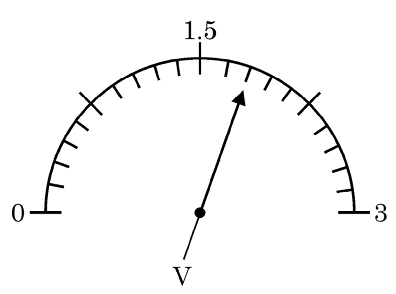
In the following diagram, the position of the needle is shown on the scale of a voltmeter. The least count of the voltmeter and the reading shown by it respectively are:
[1 mark]
The resultant magnetic field at point 'P' situated midway between two parallel wires (placed horizontally) each carrying a steady current I is
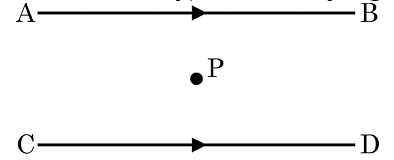
[1 mark]
For Questions number 17 to 20, two statements are given — one labelled as Assertion (A) and the other labelled as Reason (R). Select the correct answer to these questions from the codes (A), (B), (C) and (D) as given below.
Assertion (A): The colour of aqueous solution of copper sulphate turns colourless when a piece of lead is added to it.
Reason (R): Lead is more reactive than copper, and hence displaces copper from its salt solution.
[1 mark]
Assertion (A): Genes inherited from the parents decide the sex of a child.
Reason (R): X chromosome in a male child is inherited from his father.
[1 mark]
Assertion (A): Blood clotting prevents excessive loss of blood.
Reason (R): Blood clotting is due to blood plasma and white blood cells present in the blood.
[1 mark]
Assertion (A): The strength of the magnetic field produced at the centre of a current carrying circular coil increases on increasing the number of turns in it.
Reason (R): The current in each circular turn has the same direction and the magnetic field due to each turn then just adds up.
[1 mark]
SECTION B
Questions no. 21 to 26 are Very Short Answer Type questions.
(a) (i) A compound 'X' which is prepared from gypsum has the property of hardening when mixed with proper quantity of water. Identify 'X' and write its chemical formula.
(ii) State the difference in chemical composition between baking soda and baking powder.
OR
(b) Write balanced chemical equation for the reaction that occurs when:
(i) blue coloured copper sulphate crystals are heated and
(ii) Sodium hydrogen carbonate is heated during cooking.
[2 marks]
(a) Write the role of insulin in regulating blood sugar levels in human body. Mention the disease caused due to it.
(b) How is the timing and the amount of release of insulin in the blood regulated?
[2 marks]
(a) Name the type of blood (oxygenated / deoxygenated) transported by each of the following mentioning the path (i.e. from one organ (which place) to another (which place)).
(i) Vena cava
(ii) Pulmonary artery
OR
(b) With the help of a schematic flow chart, show the breakdown of glucose in a cell to provide energy
(i) in the presence of oxygen
(ii) in lack of oxygen
[2 marks]
Name the part of the human excretory system where nephrons are found. Write the structure and function of nephrons.
[2 marks]
(a) A narrow beam XY of white light is passing through a glass prism ABC as shown in the diagram.
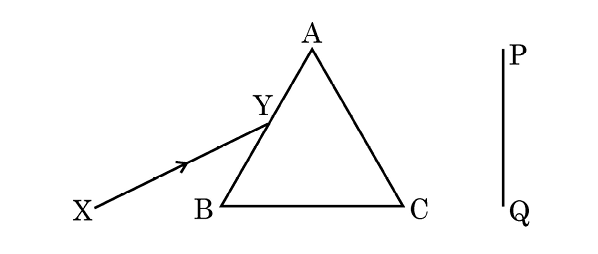
Trace it on your answer sheet and show the path of the emergent beam as observed on the screen PQ. Name the phenomenon observed and state its cause.
OR
(b) It is observed that the power of an eye to see nearby objects as well as far off objects diminishes with age.
(i) Give reason for the above statement.
(ii) Name the defect that is likely to arise in the eyes in such a condition.
(iii) Draw a labelled ray diagram to show the type of corrective lens used for restoring the vision of such an eye.
[2 marks]
How do harmful chemicals get accumulated progressively at each trophic level in a food chain?
[2 marks]
SECTION C
Questions no. 27 to 33 are Short Answer Type questions.
(a) Identify the reducing agent in the following reactions:
(i) \( \ce{4NH3 + 5O2 -> 4NO + 6H2O} \)
(ii) \( \ce{H2O + F2 -> HF + HOF} \)
(iii) \( \ce{Fe2O3 + 3CO -> 2Fe + 3CO2} \)
(iv) \( \ce{2H2 + O2 -> 2H2O} \)
(b) Define a redox reaction in terms of gain or loss of oxygen.
[3 marks]
(a) Suggest one remedial measure each to counteract the change in pH in human beings in following cases:
(i) Production of too much acid in stomach during indigestion
(ii) Stung by a honey bee / nettle leaves
(b) Fresh milk has a pH of 6. When it changes into curd will its pH increase or decrease? Why?
[3 marks]
(a) (i) State the role of ATP in cellular respiration.
(ii) What ensures sufficient exchange of gases in plants?
(iii) State the conditions on which the direction of diffusion of gases in plant depend upon.
OR
(b) (i) What is the internal energy reserve in plants and animals?
(ii) How desert plants perform photosynthesis if their stomata remain closed during the day?
[3 marks]
(a) Complete the following ray diagram to show the formation of image:
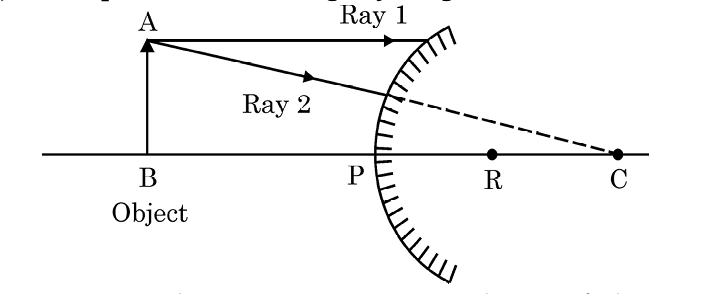
(b) Mention the nature, position and size of the image formed in this case.
(c) State the sign of the image distance in this case using the Cartesian sign convention.
[3 marks]
Give reasons for the following:
(a) Danger signals installed at airports and at the top of tall buildings are of red colour.
(b) The sky appears dark to the passengers flying at very high altitudes.
(c) The path of a beam of light passing through a colloidal solution is visible.
[3 marks]
(a) (i) State the rule used to find the force acting on a current carrying conductor placed in a magnetic field.
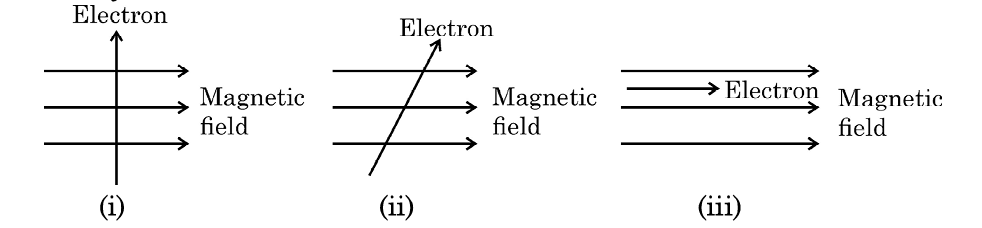
(ii) Given below are three diagrams showing entry of an electron in a magnetic field. Identify the case in which the force will be (1) maximum and (2) minimum respectively. Give reason for your answer.
OR
(b) (i) Draw the pattern of magnetic field lines of
(1) a current carrying solenoid
(2) a bar magnet
(ii) List two distinguishing features between the two fields.
[3 marks]
(a) (i) Why does a kitchen garden called an artificial ecosystem while a forest is considered to be a natural ecosystem?
(ii) While designing an artificial ecosystem at home, write any two things to be kept in mind to convert it into a self-sustaining system. Give reason to justify your answer.
OR
(b) (i) Construct a food chain of four trophic levels comprising the following: Hawk, snake, plants, rat.
(ii) 20,000 J of energy was transferred by the producers to the organism of second trophic level. Calculate the amount of energy that will be transferred by organisms of the third trophic level to the organisms of the fourth trophic level.
[3 marks]
SECTION D
Questions no. 34 to 36 are Long Answer Type questions.
(a) A saturated organic compound 'A' belongs to the homologous series of alcohols. On heating 'A' with concentrated sulphuric acid at 443 K, it forms an unsaturated compound 'B' with molecular mass 28 u. The compound 'B' on addition of one mole of hydrogen in the presence of Nickel, changes to a saturated hydrocarbon 'C'.
(i) Identify A, B and C.
(ii) Write the chemical equations showing the conversion of A into B.
(iii) What happens when compound C undergoes combustion?
(iv) State one industrial application of hydrogenation reaction.
(v) Name the products formed when compound A reacts with sodium.
OR
(b) (i) With the help of diagram, show the formation of micelles, when soap is applied on oily dirt.
(ii) Take two test tubes X and Y with 10 mL of hard water in each. In test tube 'X', add few drops of soap solution and in test tube Y add a few drops of detergent solution. Shake both the test tubes for the same period.
(1) In which test tube the formation of foam will be more ? Why?
(2) In which test tube is a curdy solid formed? Why?
[5 marks]
(a) Name the parts of a bisexual flower that are not directly involved in reproduction.
(b) Differentiate between self pollination and cross pollination. List any two significance of pollination.
(c) What is the fate of ovules and ovary after fertilization in a flower?
[5 marks]
(a) An electric iron consumes energy at a rate of 880 W when heating is at the maximum rate and 330 W when the heating is at the minimum. If the source voltage is 220 V, calculate the current and resistance in each case.
(b) What is heating effect of electric current?
(c) Find an expression for the amount of heat produced when a current passes through a resistor for some time.
[5 marks]
SECTION E
The following questions are Source-based/Case-based questions. Read the case carefully and answer the questions that follow.
Almost all metals combine with oxygen to form metal oxides. Metal oxides are generally basic in nature. But some metal oxides show both basic as well as acidic behaviour. Different metals show different reactivities towards oxygen. Some react vigorously while some do not react at all.
(a) What happens when copper is heated in air? (Give the equation of the reaction involved).
(b) Why are some metal oxides categorized as amphoteric? Give one example.
(c) Complete the following equations:
(i) \( \ce{Na2O_{(s)} + H2O_{(l)} ->} \)
(ii) \( \ce{Al2O3 + 2 NaOH ->} \)
OR
(c) On burning Sulphur in oxygen a colourless gas is produced.
(i) Write chemical equation for the reaction.
(ii) Name the gas formed.
(iii) State the nature of the gas.
(iv) What will be the action of this on a dry litmus paper?
[4 marks]
In order to trace the inheritance of traits Mendel crossed pea plants having one contrasting character or a pair of contrasting characters. When he crossed pea plants having round and yellow seeds with pea plants having wrinkled and green seeds, he observed that no plants with wrinkled and green seeds were obtained in the \( F_{1} \) generation. When the \( F_{1} \) generation pea plants were cross-bred by self-pollination, the \( F_{2} \) generation had seeds with different combinations of shape and colour also.
(a) Write any two pairs of contrasting characteristics of pea plant used by Mendel other than those mentioned above.
(b) Differentiate between dominant and recessive traits.
(c) State the ratio of the combinations observed in the seeds of \( F_{2} \) generation (in the above case). What do you interpret from this result?
OR
(c) Given below is a cross between a pure violet flowered pea plant (V) and a pure white flowered pea plant (v). Diagrammatically explain what type of progeny is obtained in \( F_{1} \) generation and \( F_{2} \) generation:
Pure violet flowered plant (VV) x Pure white flowered plant (vv)
[4 marks]
(a) List two applications of concave mirror.
(b) If the distance between the mirror and the principal focus is 15 cm, find the radius of curvature of the mirror.
(c) Draw a ray diagram to show the type of image formed when an object is placed between pole and focus of a concave mirror.
OR
(c) An object 10 cm in size is placed at 100 cm in front of a concave mirror. If its image is formed at the same point where the object is located, find:
(i) focal length of the mirror, and
(ii) magnification of the image formed with sign as per Cartesian sign convention.
[4 marks]