General Instructions : Read the following instructions carefully and follow them :
(i) This question paper contains 37 questions. All questions are compulsory.
(ii) Question paper is divided into six sections Section A, B, C, D, E and F.
(iii) Section A Questions no. 1 to 20 are Multiple Choice type questions. Each question carries 1 mark.
(iv) Section B Questions no. 21 to 24 are Very Short Answer type questions. Each question carries 2 marks. Answer to these questions should not exceed 40 words.
(v) Section C Questions no. 25 to 29 are Short Answer type questions. Each question carries 3 marks. Answer to these questions should not exceed 60 words.
(vi) Section D Questions no. 30 to 33 are Long Answer (LA) type questions. Each question carries 5 marks. Answer to these questions should not exceed 120 words.
(vii) Section E Questions no. 34 to 36 are Case/Source-based questions with three sub-questions. Each question carries 4 marks.
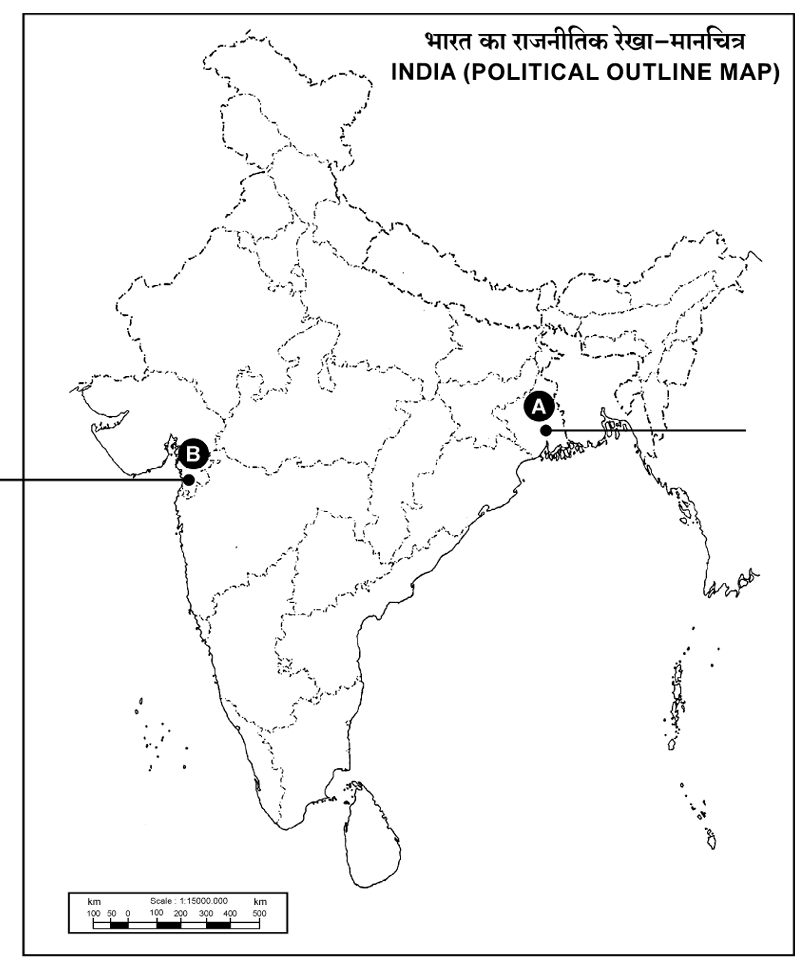
(viii) Section F Question no. 37 is Map skill-based question with two parts 37(a) from History (2 marks) and 37(b) from Geography (3 marks). This question carries total 5 marks.
(ix) In addition to this, NOTE that a separate question has been provided for Visually Impaired candidates in lieu of questions having visual inputs, map etc. Such questions are to be attempted by Visually Impaired candidates only.
SECTION A
(Multiple Choice Questions)
(20x1=20)
Match the following attributes of allegory of Germania with its significance and choose the correct option:
| Attributes | Significance |
|---|---|
| a. Broken Chains | I. Heroism |
| b. Breast-Plate with eagle | II. Readiness to fight |
| c. Crown of oak leaves | III. Strength |
| d. Sword | IV. Being free |
[1 mark]
Which one of the following aspects was common between the writings of B.R. Ambedkar and E.V. Ramaswamy Naicker?
[1 mark]
Who of the following set up the first Iron and Steel industry in India?
[1 mark]
Arrange the following in chronological order and choose the correct option:
I. The Bretton Woods conference established the International Monetary Fund.
II. The Second World War broke out between the Axis and Allied groups.
III. A car manufacturer Henry Ford adopted the 'Assembly Line Method' for production.
IV. The Western economies organized themselves as a group 'The Group of 77'.
[1 mark]
Identify the crop with the help of the following information and choose the correct option.
- This is the second most important Cereal Crop.
- This is a Rabi crop.
- It requires a cool growing season and bright sunshine at the time of ripening.
- It requires 50 to 75 cm annual rainfall.
[1 mark]
In which of the following States Tungabhadra Dam is located?
[1 mark]
Which of the following pair is correctly matched ?
[1 mark]
Which of the following countries has the highest 'Life Expectancy' at the birth?
[1 mark]
Which one of the following organization is providing data regarding employment in India?
[1 mark]
Which one of the following is a major benefit to an MNC when it works on joint production with a local company?
[1 mark]
Which one of the following pair is correctly matched ?
[1 mark]
Assume there are four families in a locality. If the monthly income of each family is ₹10,000, ₹20,000, ₹30,000 and ₹40,000, then what is the average income of the locality?
Choose the correct option from the following:
[1 mark]
Kanta works in an office. She gets her salary regularly at the end of every month. In addition to the salary, she also gets other benefits laid down by the government.
In which of the following sector Kanta is working?
[1 mark]
Which one of the following is a formal source of credit ?
[1 mark]
Consider the following statements on Power Sharing and choose the correct option:
I. It deepens democracy.
II. It helps to reduce conflicts among social groups.
III. It is a way to ensure political stability.
IV. It brings socio-economic struggles.
[1 mark]
Two statements are given below as Assertion (A) and Reason (R). Read the Statements and choose the correct option:
Assertion (A): Elections are the spirit of democracy.
Reason (R): Elections expand Political participation.
[1 mark]
Match Column - A with Column - B and choose the correct option:
| Column - A (Subjects) | Column - B (List/Subjects) |
|---|---|
| I. Defence | 1. Concurrent List |
| II. Police | 2. Union List |
| III. Marriage | 3. State List |
| IV. Computer Software | 4. Residuary Subjects |
[1 mark]
Which one of the following is the most popular form of government in the contemporary world?
[1 mark]
Two statements are given below as Assertion (A) and Reason (R). Read the statements and choose the appropriate option:
Assertion (A): Women in different parts of the World organized themselves and agitated for equal rights.
Reason (R): Women's movement aimed at equality in personal and family life as well.
[1 mark]
Which one of the following matters do NOT deal with the 'Family Laws'?
[1 mark]
SECTION B
(Very Short Answer Type Questions)
(4x2=8)
(a) Explain Romanticism as a cultural movement in Europe.
OR
(b) Explain Frederic Sorrieu's dream in the context of democratic and social republics in France during 1848.
[2 marks]
Mention any two features of Plantation agriculture.
[2 marks]
Explain any two provisions that make India a secular state.
[2 marks]
Imagine that you are the village Head. Suggest any two activities that you think should be taken up to increase the income of the villagers.
[2 marks]
SECTION C
(Short Answer Type Questions)
(5x3=15)
Explain the implication of print culture on the religious reforms in India during 19th century.
[3 marks]
How has Information Technology affected Electronic Industry? Explain.
[3 marks]
'The question of sustainability of development raises many fundamentally new issues about the nature and process of development.' Explain it with examples.
[3 marks]
Explain any three functions of Political Party.
[3 marks]
(a) Explain any three functions of the Reserve Bank of India.
OR
(b) Explain the role of banks with regard to money which they accept from the public.
[3 marks]
SECTION D
(Long Answer Type Questions)
(4x5=20)
(a) Analyse the implications of First World War on the economic and Political situation of India.
OR
(b) Analyse the role of folklore and symbols in the revival of nationalism in India during late 19th century.
[5 marks]
(a) 'Efficient means of Transport are pre-requisite for fast development.' Justify the statement.
OR
(b) 'Roadways have an edge over Railways.' Justify the statement.
[5 marks]
(a) "There is an overwhelming support for the idea of democracy all over the world." Support the statement with examples.
OR
(b) "Democracy can address all socio-economic and political problems." Support the statement with arguments.
[5 marks]
(a) Analyse the impact of globalization in India.
OR
(b) Analyse the ways to make globalization fair.
[5 marks]
SECTION E
(Case/Source-Based Questions)
(3x4=12)
Read the given case and answer the questions that follow :
Market for Goods
One way in which new consumers are created is through advertisements. As you know, advertisements make products appear desirable and necessary. They try to shape the minds of people and create new needs. Today we live in a world where advertisements surround us. They appear in newspapers, magazines, hoardings, street walls, television screens. But if we look back into history, we find that from the very beginning of the industrial age, advertisements have played a part in expanding the markets for products, and in shaping a new consumer culture.
When Manchester industrialists began selling cloth in India, they put labels on the cloth bundles. The label was needed to make the place of manufacture and the name of the company familiar to the buyer. The label was also to be a mark of quality. When buyers saw 'MADE IN MANCHESTER' written in bold on the label, they were expected to feel confident about buying the cloth.
(34.1) How was the marketing of goods done in India by the British?
(34.2) How were the new consumers created through advertisement during colonial India?
(34.3) Identify the messages conveyed through advertisements during industrialization.
[4 marks]
Read the given case and answer the questions that follow :
CONSERVATION OF ENERGY RESOURCES
Energy is a basic requirement for economic development. Every sector of the national economy agriculture, industry, transport, commercial and domestic needs inputs of energy. The economic development plans implemented since independence necessarily required increasing amounts of energy to remain operational. As a result, consumption of energy in all forms has been steadily rising all over the country.
In this background, there is an urgent need to develop a sustainable path of energy development. Promotion of energy conservation and increased use of renewable energy sources are the twin planks of sustainable energy. India is presently one of the least energy efficient countries in the world. We have to adopt a cautious approach for the judicious use of our limited energy resources. For example, as concerned citizens we can do our bit by using public transport systems instead of individual vehicles; switching off electricity when not in use, using power-saving devices and using non-conventional sources of energy. At last "Energy Saved is energy produced"
(35.1) Why is sustainable energy a key to sustainable development?
(35.2) Why is consumption of energy rising in all over India?
(35.3) Explain 'Energy saved is energy produced'.
[4 marks]
Read the given extract and answer all questions:
DECENTRALISATION IN INDIA
When power is taken away from Central and State governments and given to local government, it is called decentralization. The basic idea behind decentralization is that there are a large number of problems and issues which are best settled at the local level. People have better knowledge of problems in their localities. They also have better ideas on where to spend money and how to manage things more efficiently. Besides, at the local level it is possible for the people to directly participate in decision making. This helps to inculcate a habit of democratic participation. Local government is the best way to realise one important principle of democracy, namely local self-government.
The need for decentralisation was recognized in our Constitution. Since then, there have been several attempts to decentralize power to the level of villages and towns. Panchayats in villages and municipalities in urban areas were set up in all the States. But these were directly under the control of State Governments. Elections to these local governments were not held regularly.
(36.1) Explain Decentralization in democracy.
(36.2) Explain the importance of Local self Government in democracy.
(36.3) Describe any two steps taken by Indian government for decentralization.
[4 marks]
SECTION F
(Map Skill-Based Questions)
(2+3=5)
| (a) |
Two places (A) and (B) have been marked on the given outline political Map of India. Identify them with the help of given information and write their correct names on the lines drawn near them: (A) The place where the session of INC was held in September, 1920. (B) The place where Mahatma Gandhi broke Salt Law. |
| (b) |
On the same outline Map of India, locate and label any THREE of the following with suitable symbols:
|
Note : The following questions are for Visually Impaired Candidates only in Lieu of Q. No. 37.
(5 x 1 = 5)
Attempt any five questions:
(37.1) Name the place where the session of INC was held in September, 1920.
(37.2) Name the state where Gandhiji broke Salt Law.
(37.3) Name the place where Salal Dam is located.
(37.4) Name the state where Tarapur Nuclear Plant is located.
(37.5) Name the state where Pune Software Technology park is located.
(37.6) Name the state where 'Paradip' Sea Port is located.
[5 marks]