General Instructions :
Read the following instructions very carefully and strictly follow them :
(i) This question paper comprises five sections – Sections A, B, C, D and E. There are 13 questions in the question paper. All questions are compulsory.
(ii) Section A – Questions no. 1 to 5 are very short answer type questions, carrying 2 marks each. Answer to each question should not exceed 40 words.
(iii) Section B – Questions no. 6 to 8 are short answer type questions, carrying 3 marks each. Answer to each question should not exceed 80 words.
(iv) Section C – Questions no. 9 and 10 are long answer type questions, carrying 5 marks each. Answer to each question should not exceed 120 words.
(v) Section D – Questions no. 11 and 12 are case-based questions, carrying 4 marks each.
(vi) Section E – Question no. 13 is map-based, carrying 3 marks with two parts, 13(a) from History (1 mark) and 13(b) from Geography (2 marks).
(vii) There is no overall choice in the question paper. However, an internal choice has been provided in few questions. Only one of the choices in such questions have to be attempted.
(viii) Attach map along with your answer-book.
SECTION A
(Very Short Answer Type Questions)
(5x2 = 10)
Why did Indian merchants and industrialists support the Civil Disobedience Movement? Explain.
[2 marks]
Examine the significance of pipeline as a means of transportation in the country.
[2 marks]
Why has India adopted a multi-party system? Explain.
[2 marks]
How is 'Demand Deposit' an essential feature of money?
[2 marks]
Study the given flowchart and answer the questions that follow :
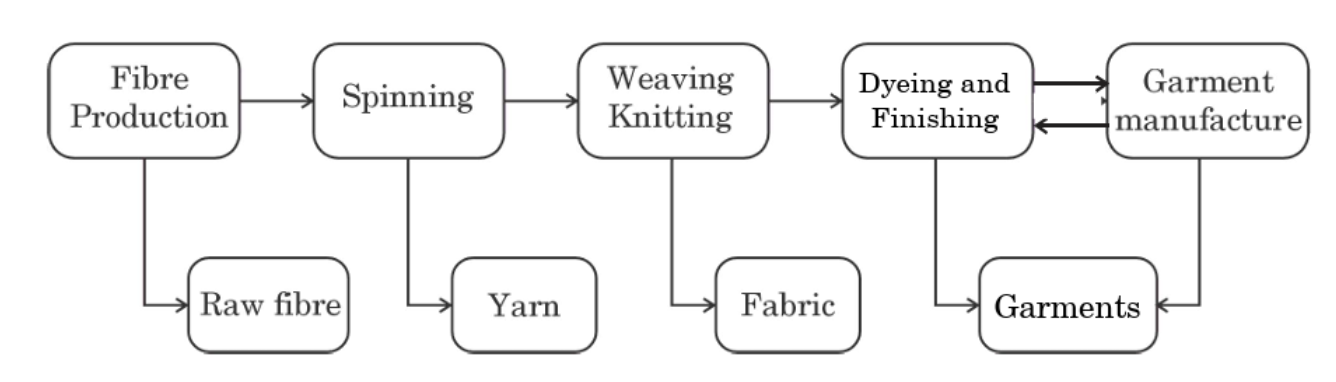
(5.1) Which is the basic material required for garment manufacturing?
(5.2) Give one example of value addition in the textile industry.
[2 marks]
SECTION B
(Short-Answer Type Questions)
(3x3 = 10)
(a) Differentiate between formal and informal sources of Credit.
OR
(b) How does a bank work as a key component of the financial system? Explain.
[3 marks]
"It was essential to preserve folk tradition in order to discover one's national identity and restore a sense of pride in one's past." Support the statement in reference to India.
[3 marks]
Explain the role of Election Commission in the 'registration and recognition' of political parties in India.
[3 marks]
SECTION C
(Long-Answer Type Questions)
(2x5 = 10)
(a) "Democracy is a better form of government than any other alternative." Analyse the statement.
OR
(b) Analyse the reasons for the overwhelming support for the idea of democracy all over the world.
[5 marks]
(a) Examine the factors which facilitate globalization in India.
OR
(b) Assess, how globalization has touched the lives of larger society.
[5 marks]
SECTION C
(Long-Answer Type Questions)
(2x5 = 10)
Read the case given below carefully and answer the questions that follow:
The Independence Day Pledge, 26 January, 1930
'We believe that it is the inalienable right of the Indian people, as of any other people, to have freedom and to enjoy the fruits of their toil and have the necessities of life, so that they may have full opportunities of growth. We believe also that if any government deprives a people of these rights and oppresses them, the people have a further right to alter it or to abolish it. The British Government in India has not only deprived the Indian people of their freedom but has based itself on the exploitation of the masses, and has ruined India economically, politically, culturally, and spiritually. We believe, therefore, that India must sever the British connection and attain Purna Swaraj or Complete Independence.'
(11.1) Why was freedom considered an inalienable right of the Indian people?
(11.2) Why was Purna Swaraj considered essential by the people of India?
(11.3) Explain the significance of the Lahore Session of Congress (1930).
[4 marks]
Read the case given below carefully and answer the questions that follow :
Lifelines of National Economy
For a long time, trade and transport were restricted to a limited space. With the development in science and technology, the area of influence of trade and transport expanded far and wide. Today, the world has been converted into a large village with the help of efficient and fast moving transport. Transport has been able to achieve this with the help of equally developed communication system. Therefore, transport, communication and trade are complementary to each other.
Today, India is well-linked with the rest of the world despite its vast size, diversity and linguistic and socio-cultural plurality. Railways, airways, waterways, newspapers, radio, television, cinema and internet, etc. have been contributing to its socio-economic progress in many ways. The trades from local to international levels have added to the vitality of its economy. It has enriched our life and added substantially to growing amenities and facilities for the comforts of life.
(12.1) How is science an important factor in the development of transport?
(12.2) How has transport integrated socio-cultural plurality? Explain.
(12.3) Analyse the significance of communication for a nation.
[4 marks]
SECTION E
(Map-Based Question)
(1+2 = 3)
| (i) |
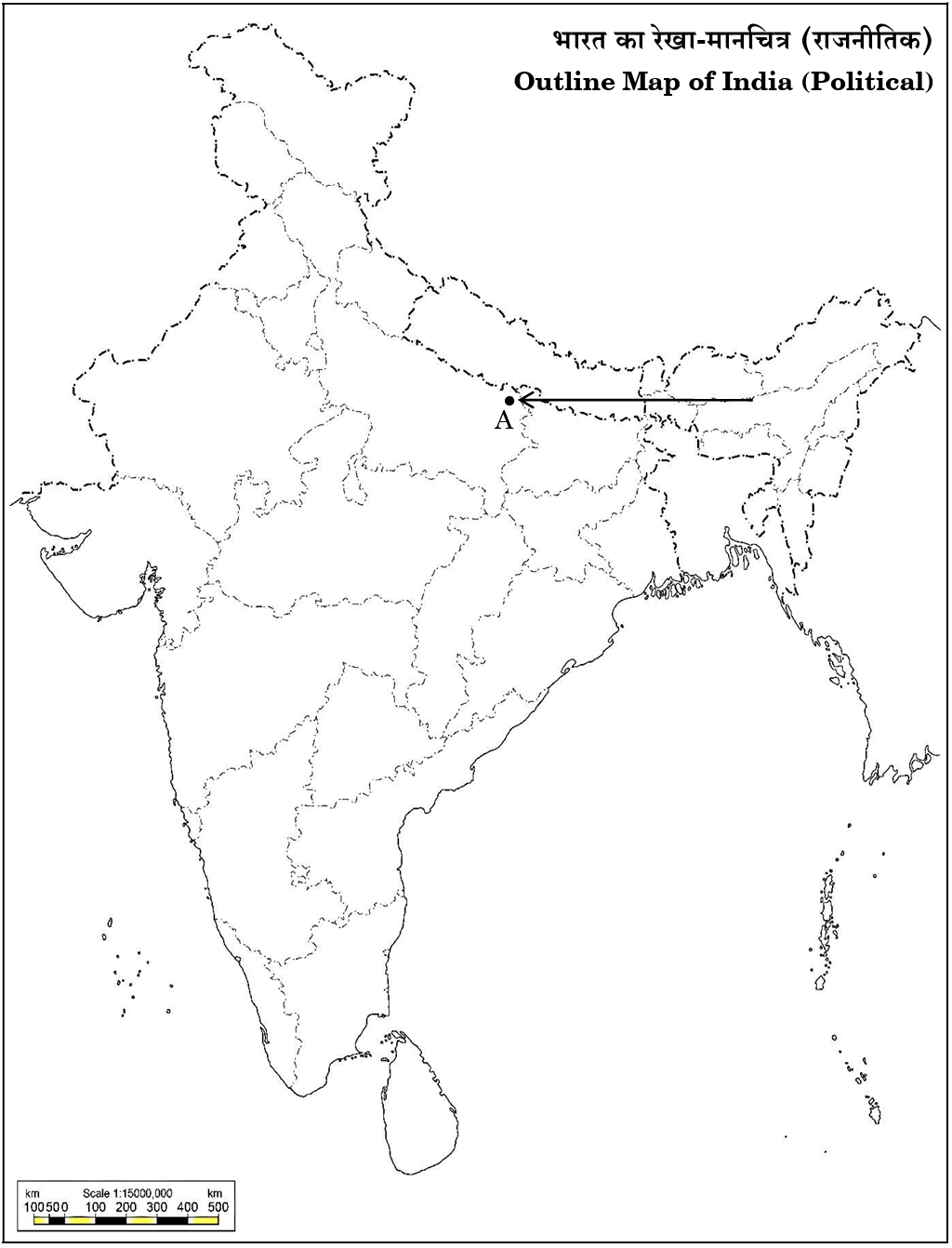
On the given political outline map of India (on page 11), identify the place marked as 'A' with the help of the following information and write its correct name on the line marked near it. A. The place where Non-Cooperation Movement was called off due to violence. |
||||||||||
| (ii) |
On the same given map of India, locate and label the following :
|
[3 marks]