Electrolysis of water is a decomposition reaction. The mass ratio $(M_{H}:M_{O})$ of hydrogen and oxygen gases liberated at the electrodes during electrolysis of water is :
[1 marks]
Assertion (A): Decomposition reactions are generally endothermic reactions.
Reason (R): Decomposition of organic matter into compost is an exothermic process.
[1 marks]
A student performs the following experiment in his school laboratory.
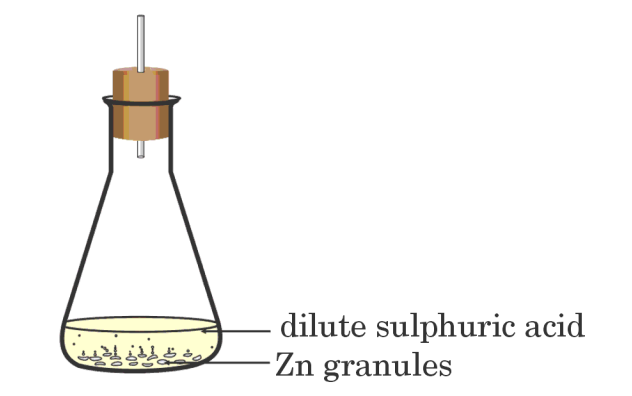
List two observations to justify that in this experiment a chemical change has taken place.
[2 marks]
Select from the following a decomposition reaction in which source of energy for decomposition is light :
[1 marks]
$\ce{MnO2 + 4HCl \rightarrow MnCl2 + 2H2O + Cl2}$
The reaction given above is a redox reaction because in this case :
[1 marks]
Name the type of chemical reaction in which calcium oxide reacts with water. Justify your answer by giving balanced chemical equation for the chemical reaction.
[2 marks]
Write one chemical equation each for the chemical reaction in which the following have taken place :
(i) Change in colour
(ii) Change in temperature
(iii) Formation of precipitate
Mention colour change/temperature change (rise/fall)/compound precipitated along with equation.
[3 marks]
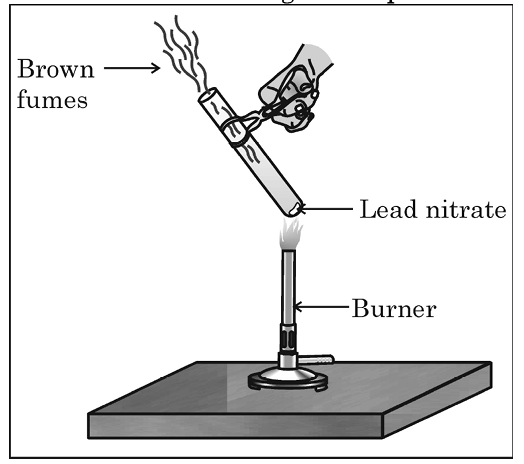
The emission of brown fumes in the given experimental set-up is due to
[1 mark]
\( \ce{MnO2 + x HCl -> MnCl2 + y H2O + z Cl2} \)
In order to balance the above chemical equation, the values of x, y and z respectively are:
[1 mark]
Assertion (A): The colour of aqueous solution of copper sulphate turns colourless when a piece of lead is added to it.
Reason (R): Lead is more reactive than copper, and hence displaces copper from its salt solution.
[1 mark]
(a) Identify the reducing agent in the following reactions:
(i) \( \ce{4NH3 + 5O2 -> 4NO + 6H2O} \)
(ii) \( \ce{H2O + F2 -> HF + HOF} \)
(iii) \( \ce{Fe2O3 + 3CO -> 2Fe + 3CO2} \)
(iv) \( \ce{2H2 + O2 -> 2H2O} \)
(b) Define a redox reaction in terms of gain or loss of oxygen.
[3 marks]