| (a) |
|
||||||
|
OR |
|||||||
| (b) |
|
[5 marks]
Carbon compounds:
(i) are good conductors of electricity.
(ii) are bad conductors of electricity.
(iii) have strong forces of attraction between their molecules.
(iv) have weak forces of attraction between their molecules.
The correct statements are:
[1 marks]
| (A) |
|
||||||||
| OR | |||||||||
| (B) |
|
[5 marks]
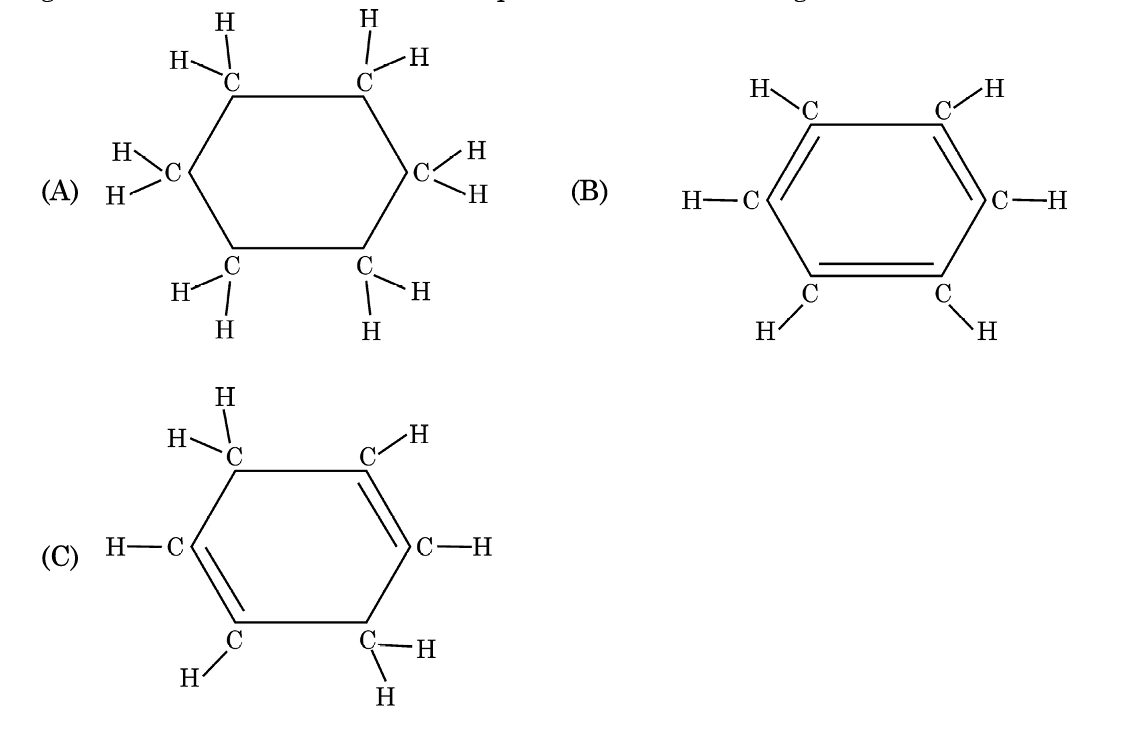
Consider the structures of the three cyclic carbon compounds A, B and C given below and select the correct option from the following:
[1 mark]
(a) A saturated organic compound 'A' belongs to the homologous series of alcohols. On heating 'A' with concentrated sulphuric acid at 443 K, it forms an unsaturated compound 'B' with molecular mass 28 u. The compound 'B' on addition of one mole of hydrogen in the presence of Nickel, changes to a saturated hydrocarbon 'C'.
(i) Identify A, B and C.
(ii) Write the chemical equations showing the conversion of A into B.
(iii) What happens when compound C undergoes combustion?
(iv) State one industrial application of hydrogenation reaction.
(v) Name the products formed when compound A reacts with sodium.
OR
(b) (i) With the help of diagram, show the formation of micelles, when soap is applied on oily dirt.
(ii) Take two test tubes X and Y with 10 mL of hard water in each. In test tube 'X', add few drops of soap solution and in test tube Y add a few drops of detergent solution. Shake both the test tubes for the same period.
(1) In which test tube the formation of foam will be more ? Why?
(2) In which test tube is a curdy solid formed? Why?
[5 marks]
| (a) |
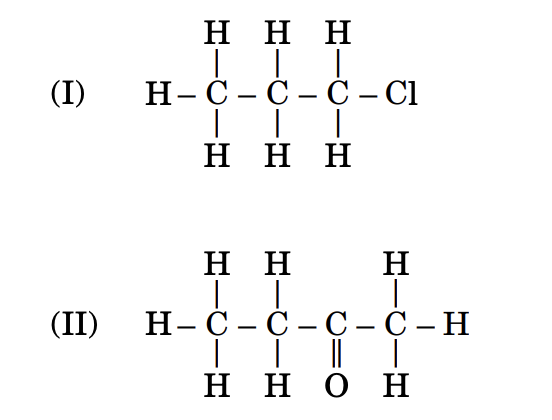
Write the molecular formula of the following carbon compounds :
|
| (b) | Carbon compounds have low melting and boiling points. Why? |
[2 marks]
| (a) |
Draw two different possible structures of a saturated hydrocarbon having four carbon atoms in its molecule. What are these two structures of the hydrocarbon having same molecular formula called? Write the molecular formula and the common name of this compound. Also write the molecular formula of its alkyne. |
||||||
| OR | |||||||
| (b) |
|
[3 marks]