Assertion (A): No two magnetic field lines are found to cross each other.
Reason (R): The compass needle cannot point towards two directions at the point of intersection of two magnetic field lines.
[1 marks]
In our homes, we receive the supply of electric power through a main supply also called mains, either supported through overhead electric poles or by underground cables. In our country the potential difference between the two wires (live wire and neutral wire) of this supply is 220 V.
| (a) | Write the colours of the insulation covers of the line wires through which supply comes to our homes. |
| (b) | What should be the current rating of the electric circuit (220 V) so that an electric iron of 1 kW power rating can be operated? |
| (c) | (i) What is the function of the earth wire? State the advantage of the earth wire in domestic electric appliances such as electric iron. |
| OR | |
| (c) | (ii) List two precautions to be taken to avoid electrical accidents. State how these precautions prevent possible damage to the circuit/appliance. |
[4 marks]
The pattern of the magnetic field produced inside a current carrying solenoid is:
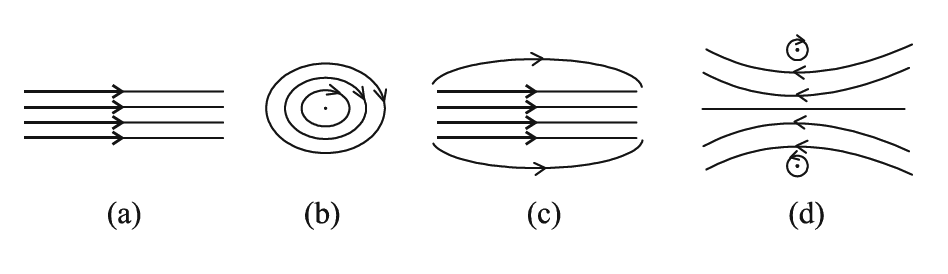
[1 marks]
- Two magnetic field lines do not intersect each other. Why?
- How is a uniform magnetic field in a given region represented ? Draw a diagram in support of your answer.
[2 marks]
Name and state the rule to determine the direction of a:
(i) magnetic field produced around a current carrying straight conductor.
(ii) force experienced by a current carrying straight conductor placed in a magnetic field which is perpendicular to it.
[3 marks]
In domestic electric circuits the wiring with 15 A current rating is for the electric devices which have
[1 mark]
The resultant magnetic field at point 'P' situated midway between two parallel wires (placed horizontally) each carrying a steady current I is
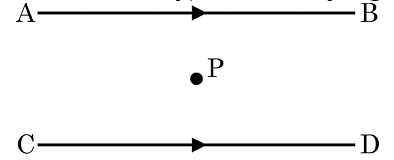
[1 mark]
Assertion (A): The strength of the magnetic field produced at the centre of a current carrying circular coil increases on increasing the number of turns in it.
Reason (R): The current in each circular turn has the same direction and the magnetic field due to each turn then just adds up.
[1 mark]
(a) (i) State the rule used to find the force acting on a current carrying conductor placed in a magnetic field.
(ii) Given below are three diagrams showing entry of an electron in a magnetic field. Identify the case in which the force will be (1) maximum and (2) minimum respectively. Give reason for your answer.
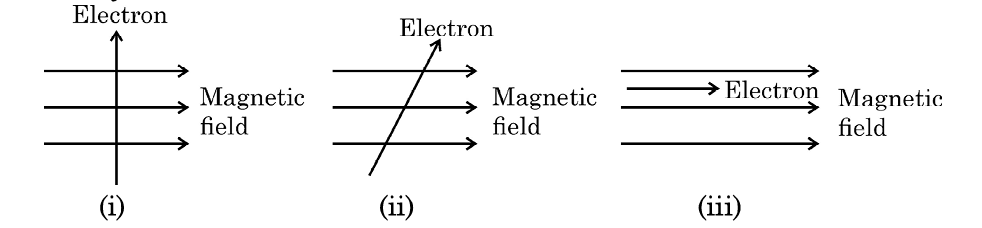
OR
(b) (i) Draw the pattern of magnetic field lines of
(1) a current carrying solenoid
(2) a bar magnet
(ii) List two distinguishing features between the two fields.
[3 marks]
| (a) |
|
||||
| OR | |||||
| (b) |
|
[2 marks]
A student fixes a sheet of white paper on a drawing board using some adhesive materials. She places a bar magnet in the centre of it and sprinkles some iron filings uniformly around the bar magnet using a salt-sprinkler. On tapping the board gently, she observes that the iron filings have arranged themselves in a particular pattern.
| (a) |
Draw a diagram to show this pattern of iron filings. |
||||||
| (b) |
Draw the magnetic field lines of a bar magnet showing the poles of the bar magnet as well as the direction of the magnetic field lines. |
||||||
| (c) |
|
[4 marks]