The products formed when Aluminium and Magnesium are burnt in the presence of air respectively are:
[1 marks]
Reaction between two elements A and B, forms a compound C. A loses electrons and B gains electrons. Which one of the following properties will not be shown by compound C?
[1 marks]
The metals obtained from their molten chlorides by the process of electrolytic reduction are:
[1 marks]
The formation of magnesium oxide is correctly shown in option :
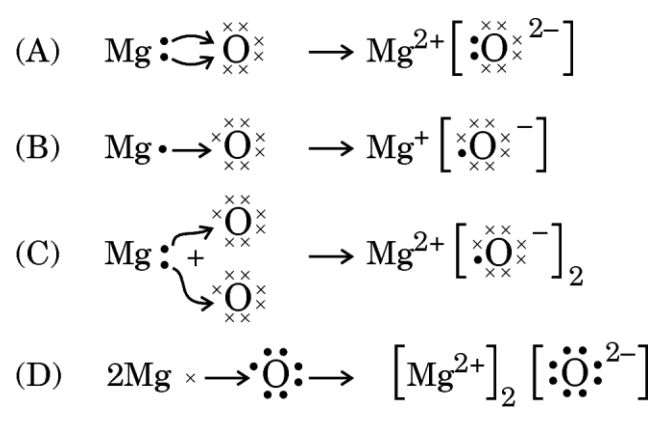
[1 marks]
| (a) | "Displacement reactions also play a key role in extracting metals in the middle of the reactivity series." Justify this statement with two examples. |
| (b) | Why can metals high up in the reactivity series not be obtained by reduction of their oxides by carbon ? |
[3 marks]
| (a) | With the help of an activity, explain the conditions under which iron articles get rusted. | ||||
| OR | |||||
| (b) |
|
[3 marks]
A metal and a non-metal that exists in liquid state at the room temperature are respectively:
[1 marks]
Oxides of aluminium and zinc are:
Two statements are given - One labelled as Assertion (A) and the other labelled as Reason (R). Select the correct answer to these questions from the codes (a), (b), (c) and (d) as given below :
- Assertion (A): Hydrogen gas is not evolved when zinc reacts with nitric acid.
- Reason (R): Nitric acid oxidises the hydrogen gas produced to water and itself gets reduced.
[1 marks]
Q. Nos. are source-based/case-based questions with 2 to 3 short sub-parts. Internal choice is provided in one of these sub-parts :
The metals produced by various reduction processes are not very pure. They contain impurities, which must be removed to obtain pure metals. The most widely used method for refining impure metals is electrolytic refining.
(i) What is the cathode and anode made of in the refining of copper by this process?
(ii) Name the solution used in the above process and write its formula.
(iii) (A) How copper gets refined when electric current is passed in the electrolytic cell?
OR
(iii) (B) You have two beakers 'A' and 'B' containing copper sulphate solution. What would you observe after about 2 hours if you dip a strip of zinc in beaker 'A' and a strip of silver in beaker 'B'? Give reason for your observations in each case.
[4 marks]
SECTION - A
Select and write one most appropriate option out of the four options given for each of the questions 1 - 20:
A metal 'X' is used in thermite process. When X is burnt in air it gives an amphoteric oxide 'Y'. 'X' and 'Y' are respectively:
[1 mark]
Almost all metals combine with oxygen to form metal oxides. Metal oxides are generally basic in nature. But some metal oxides show both basic as well as acidic behaviour. Different metals show different reactivities towards oxygen. Some react vigorously while some do not react at all.
(a) What happens when copper is heated in air? (Give the equation of the reaction involved).
(b) Why are some metal oxides categorized as amphoteric? Give one example.
(c) Complete the following equations:
(i) \( \ce{Na2O_{(s)} + H2O_{(l)} ->} \)
(ii) \( \ce{Al2O3 + 2 NaOH ->} \)
OR
(c) On burning Sulphur in oxygen a colourless gas is produced.
(i) Write chemical equation for the reaction.
(ii) Name the gas formed.
(iii) State the nature of the gas.
(iv) What will be the action of this on a dry litmus paper?
[4 marks]