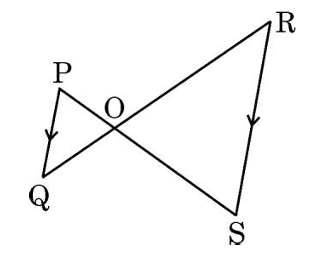
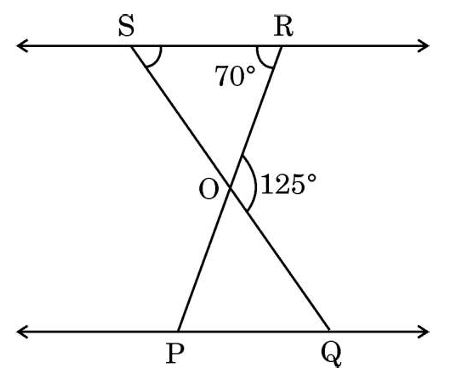
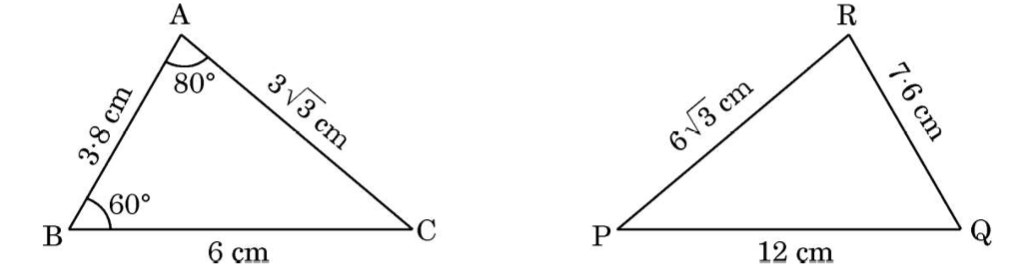
In triangles ABC and DEF, $\angle B=\angle E$, $\angle F=\angle C$ and $AB=3DE$. Then, the two triangles are:
[1]
(a) If $\Delta ABC\sim\Delta PQR$ in which $AB=6\text{ cm}$, $BC=4\text{ cm}$, $AC=8\text{ cm}$ and $PR=6\text{ cm}$, then find the length of $(PQ+QR)$.
OR
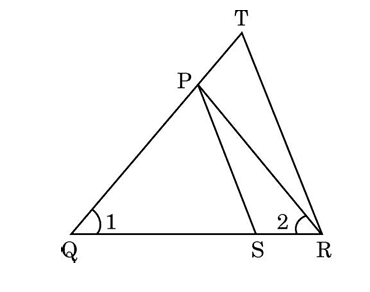
(b) In the given figure, $\frac{QR}{QS}=\frac{QT}{PR}$ and $\angle 1=\angle 2$, show that $\Delta PQS\sim\Delta TQR$.
[2]
(a) The diagonal BD of a parallelogram ABCD intersects the line segment AE at the point F, where E is any point on the side BC. Prove that $DF\times EF=FB\times FA$.
OR
(b) In $\Delta ABC$, if $AD\perp BC$ and $AD^{2}=BD\times DC$, then prove that $\angle BAC=90^{\circ}$.
[5]
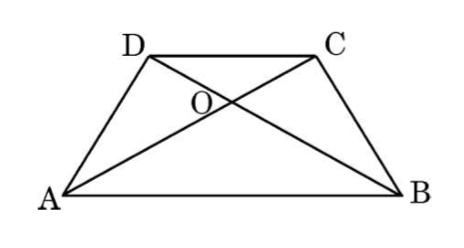
In the given figure, ABCD is a quadrilateral. Diagonal BD bisects $\angle B$ and $\angle D$ both. Prove that:
(i) $\Delta ABD\sim\Delta CBD$
(ii) $AB=BC$
[2 marks]
If a line is drawn parallel to one side of a triangle to intersect the other two sides in distinct points, then prove that the other two sides are divided in the same ratio.
[5 marks]
In the given figure PA, QB and RC are each perpendicular to AC. If $AP=x$, $BQ=y$ and $CR=z$, then prove that $\frac{1}{x}+\frac{1}{z}=\frac{1}{y}$
- - - - INSERT IMAGE HERE - - - -[5 marks]
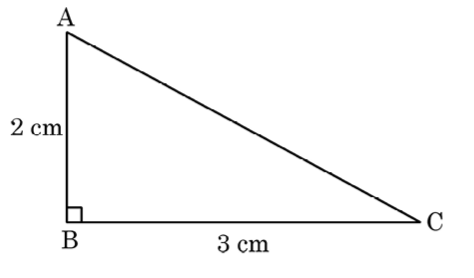
Assertion (A): The perimeter of \( \Delta ABC \) is a rational number.
Reason (R): The sum of the squares of two rational numbers is always rational.
[1 mark]
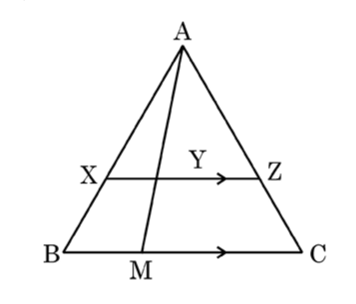
In the given figure, XZ is parallel to BC. \( AZ=3 \text{ cm} \), \( ZC=2 \text{ cm} \), \( BM=3 \text{ cm} \) and \( MC=5 \text{ cm} \).
Find the length of XY.
[2 marks]
If a line is drawn parallel to one side of a triangle to intersect the other two sides at distinct points, prove that the other two sides are divided in the same ratio.
[5 marks]
 [1 marks]