Assertion (A): If we join two hemispheres of same radius along their bases, then we get a sphere.
Reason (R): Total Surface Area of a sphere of radius r is $3\pi r^{2}$.
[1]
A room is in the form of a cylinder surmounted by a hemispherical dome. The base radius of the hemisphere is half of the height of the cylindrical part. If the room contains $\frac{1408}{21}\text{ m}^{3}$ of air, find the height of the cylindrical part. (Use $\pi=\frac{22}{7}$).
[3]
A solid sphere is cut into two hemispheres. The ratio of the surface areas of sphere to that of two hemispheres taken together, is :
[1 mark]
The volume of the largest right circular cone that can be carved out from a solid cube of edge 2 cm is:
[1 mark]
The difference between the outer and inner radii of a hollow right circular cylinder of length 14 cm is 1 cm. If the volume of the metal used in making the cylinder is $176~cm^{3}$, find the outer and inner radii of the cylinder.
[3 marks]
Curved surface area of a cylinder of height 5 cm is \( 94.2 \text{ cm}^{2} \). Radius of the cylinder is (Take \( \pi=3.14 \))
[1 mark]
The curved surface area of a cone having height 24 cm and radius 7 cm, is
[1 mark]
(a) A room is in the form of cylinder surmounted by a hemi-spherical dome. The base radius of hemisphere is one-half the height of cylindrical part. Find total height of the room if it contains \( \left(\frac{1408}{21}\right) \text{ m}^{3} \) of air. (Take \( \pi=\frac{22}{7} \))
OR
(b) An empty cone is of radius 3 cm and height 12 cm. Ice-cream is filled in it so that lower part of the cone which is \( \left(\frac{1}{6}\right)^{th} \) of the volume of the cone is unfilled but hemisphere is formed on the top. Find volume of the ice-cream. (Take \( \pi=3.14 \))
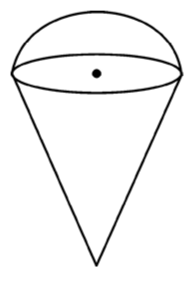
[3 marks]
A solid metallic sphere of radius 10.5 cm is melted and recast into a number of smaller cones, each of radius 3.5 cm and height 3 cm. Find the number of cones so formed.
[2 marks]
(a) From a solid cylinder of height 30 cm and radius 7 cm, a conical cavity of height 24 cm and same radius is hollowed out. Find the total surface area of the remaining solid.
OR
(b) Water in a canal, 8 m wide and 6 m deep, is flowing with a speed of \(12~\text{km/hour}\). How much area will it irrigate in one hour, if 0.05 m of standing water is required?
[4 marks]