If $\alpha$ and $\beta$ are the zeroes of polynomial $3x^{2}+6x+k$ such that $\alpha+\beta+\alpha\beta=-\frac{2}{3}$, then the value of k is:
[1]
Two polynomials are shown in the graph below. The number of distinct zeroes of both the polynomials is :
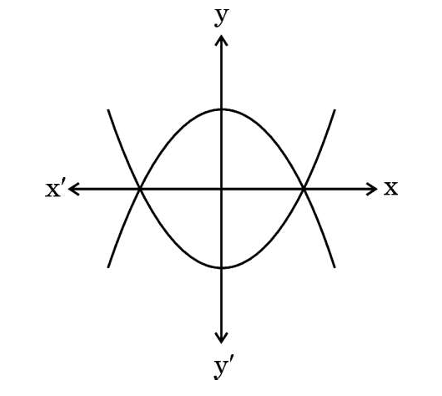
[1]
Find the zeroes of the polynomial $p(x)=x^{2}+\frac{4}{3}x-\frac{4}{3}$
[2]
If the sum of zeroes of the polynomial $p(x)=2x^{2}-k\sqrt{2}x+1$ is $\sqrt{2}$, then value of k is:
[1 mark]
The zeroes of a polynomial $x^{2}+px+q$ are twice the zeroes of the polynomial $4x^{2}-5x-6$. The value of p is :
[1 mark]
Assertion (A): If the graph of a polynomial touches x-axis at only one point, then the polynomial cannot be a quadratic polynomial.
Reason (R): A polynomial of degree $n(n>1)$ can have at most n zeroes.
[1 mark]
The graph of \( y=p(x) \) is given, for a polynomial \( p(x) \). The number of zeroes of \( p(x) \) from the graph is
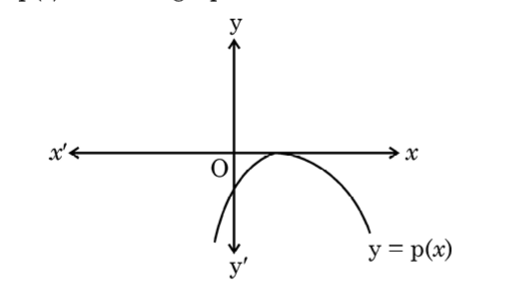
[1 mark]
If \( \alpha \), \( \beta \) are the zeroes of a polynomial \( p(x)=x^{2}+x-1 \), then \( \frac{1}{\alpha}+\frac{1}{\beta} \) equals to
[1 mark]
Which of the following is a quadratic polynomial having zeroes \( \frac{-2}{3} \) and \( \frac{2}{3} \)?
[1 mark]