If the sum of first m terms of an AP is $2m^{2}+3m$, then its second term is :
[1]
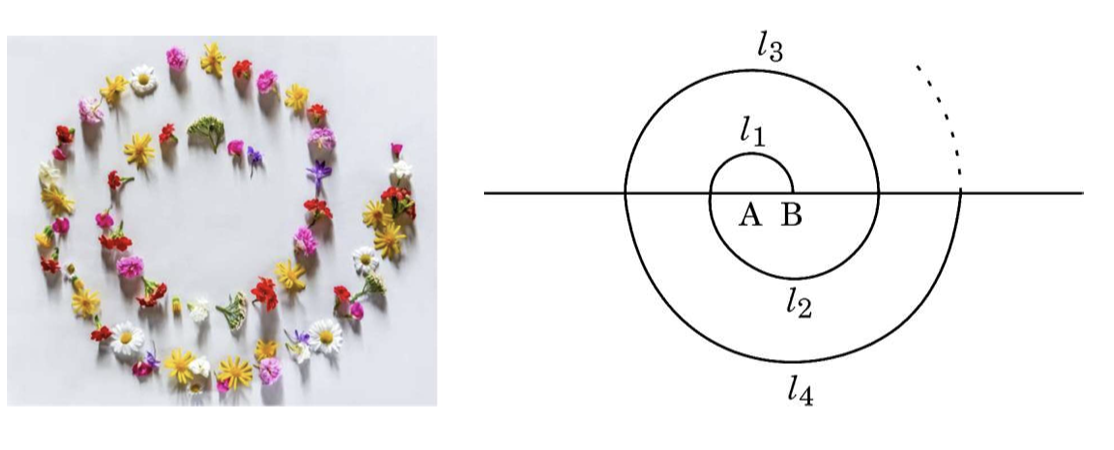
A school is organizing a charity run to raise funds for a local hospital. The run is planned as a series of rounds around a track, with each round being 300 metres. To make the event more challenging and engaging, the organizers decide to increase the distance of each subsequent round by 50 metres. For example, the second round will be 350 metres, the third round will be 400 metres and so on. The total number of rounds planned is 10.
Based on the information given above, answer the following questions:
| (i) |
Write the fourth, fifth and sixth term of the Arithmetic Progression so formed. |
||||||
| (ii) | Determine the distance of the $8^{th}$ round. | ||||||
| (iii) |
|
[4]
In an A.P., if the first term $a=7$, nth term $a_{n}=84$ and the sum of first n terms $s_{n}=\frac{2093}{2}$, then n is equal to:
[1 mark]
The sum of first and eighth terms of an A.P. is 32 and their product is 60. Find the first term and common difference of the A.P. Hence, also find the sum of its first 20 terms.
[5 marks]
In an A.P. of 40 terms, the sum of first 9 terms is 153 and the sum of last 6 terms is 687. Determine the first term and common difference of A.P. Also, find the sum of all the terms of the A.P.
[5 marks]
If \( p-1 \), \( p+1 \) and \( 2p+3 \) are in A.P., then the value of p is
[1 mark]
(a) The ratio of the \( 11^{th} \) term to \( 17^{th} \) term of an A.P. is 3: 4. Find the ratio of \( 5^{th} \) term to \( 21^{st} \) term of the same A.P. Also, find the ratio of the sum of first 5 terms to that of first 21 terms.
OR
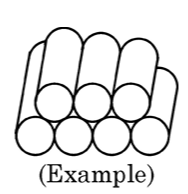
(b) 250 logs are stacked in the following manner: 22 logs in the bottom row, 21 in the next row, 20 in the row next to it and so on (as shown by an example). In how many rows, are the 250 logs placed and how many logs are there in the top row?
[5 marks]
(a) Find the sum of first 30 terms of AP: 30, -24, -18, ...
OR
(b) In an AP if \(S_{n}=n(4n+1)\), then find the AP.
[2 marks]
Case Study - 1
In Mathematics, relations can be expressed in various ways. The matchstick patterns are based on linear relations. Different strategies can be used to calculate the number of matchsticks used in different figures. One such pattern is shown below. Observe the pattern and answer the following questions using Arithmetic Progression:
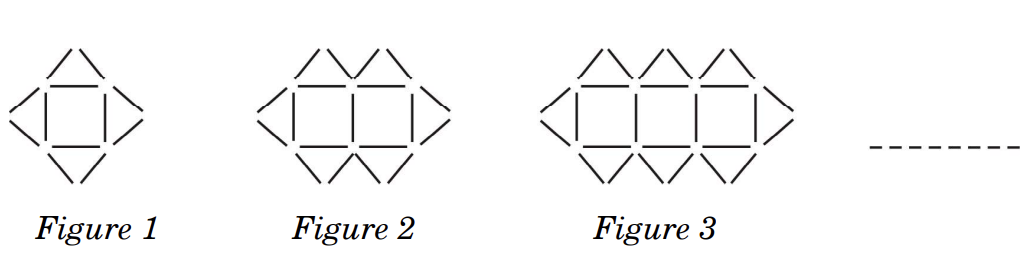
(a) Write the AP for the number of triangles used in the figures. Also, write the nth term of this AP.
(b) Which figure has 61 matchsticks?
[4 marks]